


Classic Sudoku remains excellent, yet many solvers eventually look for rule-twist Sudoku variants that force genuinely different kinds of reasoning. Entropic Lines, Killer-Thermo hybrids and Arrow-Jigsaw combinations continue to produce some of the cleanest and most satisfying logic in the current variant landscape. These approaches reward careful tracking, spatial insight and the interplay of multiple constraints rather than mechanical elimination. None of these are brand-new inventions, and none need hype percentages. They simply keep appearing because they generate clean, memorable logic.
Entropic Lines: Balance Without Numbers
Entropic (or Entropy) Lines emerged in the early 2020s, largely through the work of setters such as Raumplaner and JeremyDover, and have remained a reliable tool ever since. The rule is simple and elegant:
Any three consecutive cells along the line must contain one low digit (1–3), one middle digit (4–6), and one high digit (7–9). Digits may repeat on the line provided no other rule is broken.
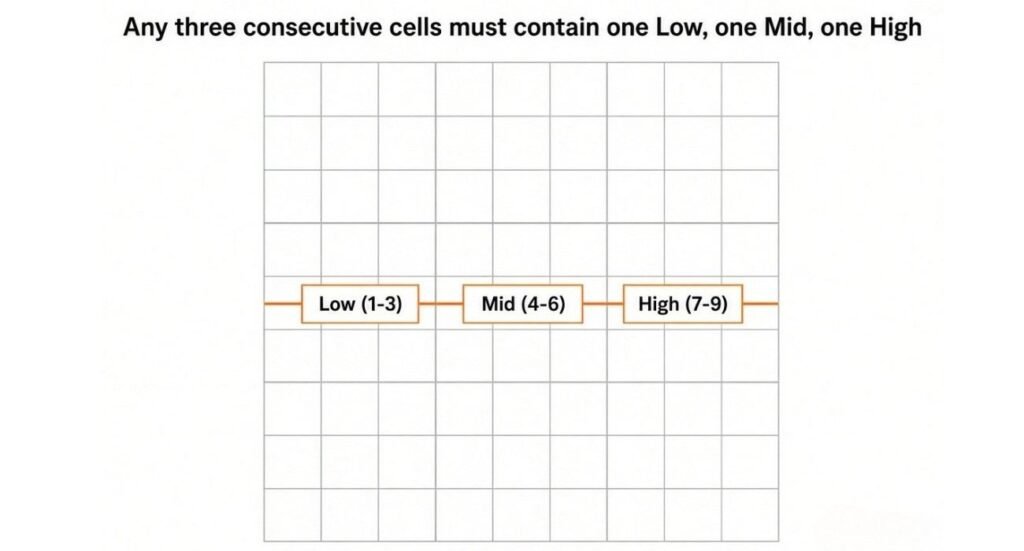
What makes the constraint powerful is that it is about distribution rather than magnitude or order. You are forced to track which “bands” have already appeared and which still need representation. A short line of three cells immediately becomes a complete set of one low, one mid, and one high. Longer lines create repeating cycles (LMH or LHM patterns, for example). When these lines interact with boxes or with other constraints, you get forced placements that pure Sudoku logic would never produce.
The best examples feel almost inevitable once the pattern clicks. You start noticing that certain cells must be high because two lows and a mid are already accounted for nearby, or that an entire segment of a line is restricted to a single band. These are the kinds of deductions that feel satisfying rather than laborious. The constraint also resists the more brute-force AI approaches that excel at classic Sudoku, because the logic is local, cyclical, and often visual.
You will still find high-quality Entropic Line puzzles on Logic Masters Germany and in the Genuinely Approachable Sudoku (GAS) series. They reward careful tracking more than advanced candidate techniques.
Killer + Thermo (and Similar Ordering Hybrids)
Killer Sudoku has long been the most widely played variant after the classic form: cages with given sums, no repeats inside cages, plus normal Sudoku rules. Adding thermometers changes the character of the puzzle. Digits must strictly increase from the bulb end of each thermo. Suddenly the same cage that once offered several possible combinations is constrained by direction and sequence.
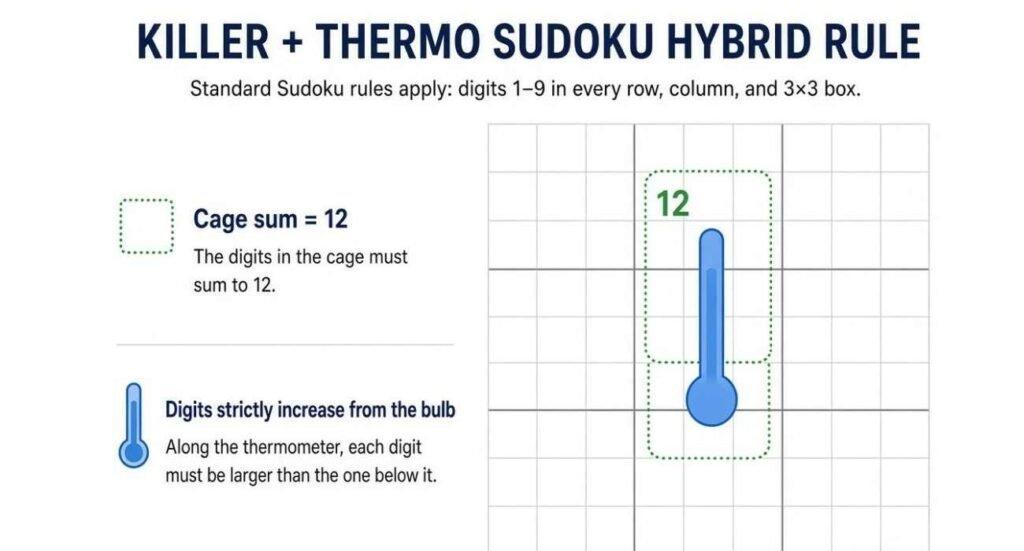
The interaction is often sharper than either constraint alone. A short thermo that sits inside a modest cage can eliminate large numbers of candidate sets at once. Conversely, a cage sum can force the starting or ending values on a thermo far more tightly than the thermometer shape by itself would allow. Setters who understand both systems can create long chains of forced placements that feel elegant rather than grinding.
These hybrids appear regularly on Cracking the Cryptic and in independent constructor collections. They reward solvers who are comfortable switching between arithmetic possibility lists and strict ordering. The difficulty can range from approachable to brutal depending on how the cages and thermos interlock; the best ones make the two constraints feel like partners rather than competing demands.
Arrow + Irregular Regions
Arrow Sudoku is another well-established variant: the digit in a circle equals the sum of the digits along the attached arrow (digits may repeat on the arrow if Sudoku rules permit). Jigsaw (or irregular) Sudoku replaces the usual 3×3 boxes with nine contiguous regions of nine cells each.
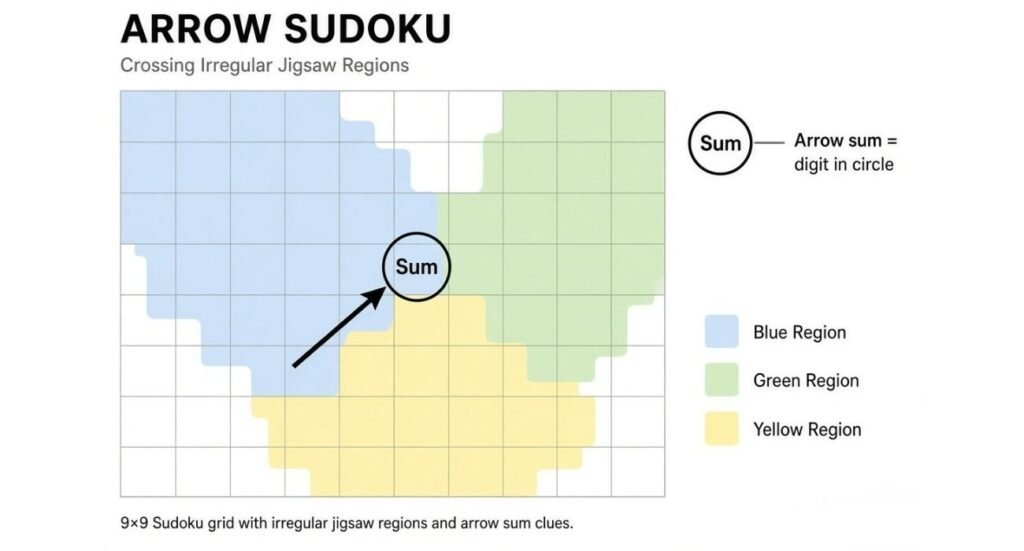
When the two are combined, the puzzle becomes strongly visual. The irregular regions force you to relearn basic scanning—pointing pairs and box-line interactions no longer behave the way muscle memory expects. At the same time the arrows supply concrete sum information that can cut through the spatial uncertainty. Overlaps between an arrow and a jigsaw region frequently produce the key breakthroughs: a short arrow that must live almost entirely inside one irregular region, or a long arrow that crosses several regions and therefore carries strong global information.
These grids tend to look distinctive on the page or screen, which is part of their appeal. They also demand a different mental map from classic or even standard Killer Sudoku. Solvers who enjoy spatial reasoning often find them more engaging than pure sum or pure ordering variants.
Why These Approaches Endure?
Good variant design is not about piling on rules. It is about choosing constraints that interact productively with the existing Sudoku skeleton and with each other. Entropic Lines give you range balance. Killer + Thermo gives you arithmetic under directional pressure. Arrow + Jigsaw gives you sums under spatial irregularity. Each pushes a different cognitive muscle: distribution tracking, sequence-plus-sum reasoning, or spatial-sum coordination.
The broader ecosystem supports this kind of experimentation. Channels such as Cracking the Cryptic have made complex variants accessible to large audiences. Sites like Logic Masters Germany provide a steady stream of rated, commentable puzzles. Tools such as SudokuPad and f-puzzles lower the barrier for both solving and setting. The result is a living craft rather than a static list of “trending” formats.
If classic Sudoku has started to feel automatic, these three directions are worth exploring—not because they are the official variants of any particular year, but because they consistently produce moments of genuine insight. Start with a short Entropic Line puzzle to feel the rhythm of the bands, move to a modest Killer-Thermo hybrid to experience the interplay of sum and order, then try an Arrow-Jigsaw grid to reset your sense of region. The logic will feel fresher, and the “aha” moments more earned.
Conclusion
Classic Sudoku remains a near-perfect exercise in pure elimination. The variants discussed here do not replace it; they simply open different channels of reasoning—range balance, ordered arithmetic, and spatial-sum coordination. When the constraints are well designed, the resulting logic feels inevitable rather than forced. That quality, more than any trend label, is what keeps experienced solvers returning to these forms. The best next step is simply to open a short Entropic Line puzzle, a modest Killer-Thermo hybrid or a clean Arrow-Jigsaw grid and pay attention to the moment the extra constraint first changes what you can see.
FAQs
Q.1: Where can I find good examples of these?
Ans: Logic Masters Germany remains the most reliable public archive for rated, commentable puzzles. Cracking the Cryptic’s YouTube channel and associated apps regularly feature strong hybrids. The Genuinely Approachable Sudoku (GAS) series is especially useful for clean Entropic Line introductions. SudokuPad and f-puzzles make it easy to try most of these online without downloading anything.
Q.2: Are these suitable for relative beginners?
Ans: Entropic Lines can be approachable once the low/mid/high bands are understood; short lines often give immediate footholds. Killer-Thermo hybrids and Arrow-Jigsaw grids usually require more comfort with candidate tracking and spatial scanning. Starting with simpler standalone versions of Thermo, Arrow, or Killer before combining them is the more sustainable path.
Q.3: Do these constraints really challenge computer solvers more than classic Sudoku?
Ans: They can, especially when multiple interacting constraints create long chains of local deductions that are natural for humans but less efficient for pure search or pattern-matching approaches. The difference is one of degree rather than absolute resistance; well-written solvers still handle most published variants. The practical value for human solvers is the richer logic, not any guaranteed “AI-proof” status.

Sweta MS is the founder and editor of Sudoku Times. A passionate Sudoku enthusiast and logic puzzle solver for over 12 years, she has solved thousands of puzzles ranging from easy to expert level. Sweta specializes in breaking down advanced solving techniques (X-Wing, Swordfish, XY-Wing and more) into clear, practical guides that help beginners and intermediate players improve faster. Through Sudoku Times, she shares daily puzzles, strategy tutorials and insights into how Sudoku trains the brain. Her goal is to make high-quality Sudoku content accessible, enjoyable and effective for players of all skill levels.