
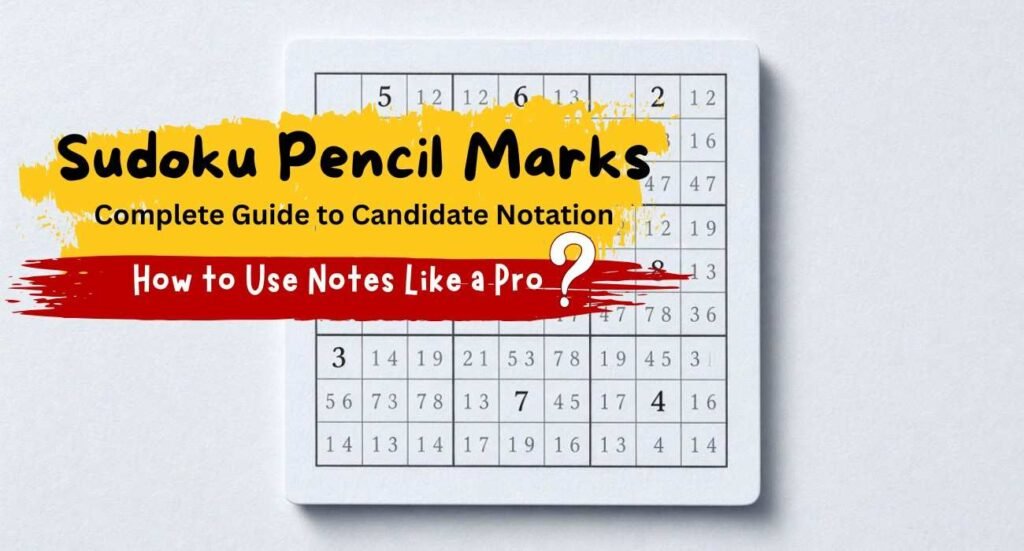

Pencil marks (also called candidates, notes, or possibles) are the single most important tool for solving medium, hard, and expert Sudoku puzzles. Without them, advanced techniques become nearly impossible. With them, patterns jump out and solving becomes systematic instead of guesswork.
This guide covers everything you need to master Sudoku pencil marks — from absolute basics to pro-level habits that keep your grid clean and your solving fast.
What Are Sudoku Pencil Marks?
Pencil marks are small numbers written inside an empty cell that show every digit that can still legally go there.
A digit is a valid candidate only if it does not already appear in:
- The same row
- The same column
- The same 3×3 box
Once those three “buddy” units are checked, the remaining digits become the cell’s pencil marks.
Example
If a cell’s row already has 1, 4 and 7, its column has 2, 5 and 9, and its box has 3 and 6, then the only remaining candidates are 8. That cell is now a naked single and can be filled immediately.
On paper you write them lightly with a pencil so they can be erased. In digital apps (including the interactive grids on Sudoku Times) there is usually a dedicated “Notes” or “Pencil Mark” mode.
Why Pencil Marks Are Essential
Easy puzzles can often be solved by pure scanning. Medium and harder puzzles cannot.
Pencil marks turn the puzzle from a memory exercise into a visible elimination game. They make these techniques possible:
- Naked singles and hidden singles
- Naked pairs, triples, and quads
- Locked candidates (pointing pairs / claiming)
- X-Wing, Swordfish, Jellyfish
- XY-Wing, W-Wing, and other advanced patterns
For details on these techniques visit – Advance Sudoku Strategies for Experts
Without accurate candidates, you are constantly re-calculating possibilities in your head. With them, the logic is written on the grid.
When Should You Start Using Pencil Marks?
Do not mark the entire grid at the very beginning of an easy or medium puzzle. That wastes time and creates clutter.
Best practice:
- Scan the whole grid for naked singles and hidden singles first.
- Place every obvious digit you can find.
- Only when scanning no longer produces easy placements, begin adding pencil marks.
A practical rule of thumb used by many strong solvers: if a cell takes more than 3–5 seconds to evaluate by eye, it is time to write candidates.
How to Add Pencil Marks (Step-by-Step)
- Choose an empty cell.
- Mentally (or on paper) list digits 1–9.
- Eliminate every digit that already appears in the cell’s row.
- Eliminate every digit that already appears in the cell’s column.
- Eliminate every digit that already appears in the cell’s 3×3 box.
- Write the remaining digits as small pencil marks inside the cell.
Repeat for every empty cell (or at least the ones that still have multiple possibilities).
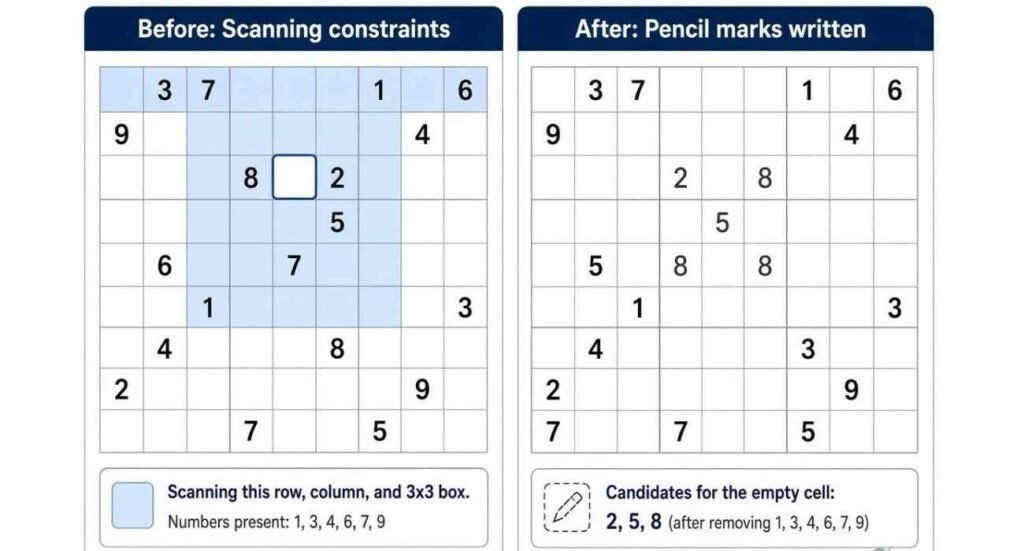
Pro tip: Start with the most constrained cells (those that already look like they have only two or three possibilities). This often reveals singles or pairs quickly and reduces the amount of marking you need to do.
Notation Systems: Full Candidates vs Snyder Notation
There are two main approaches:
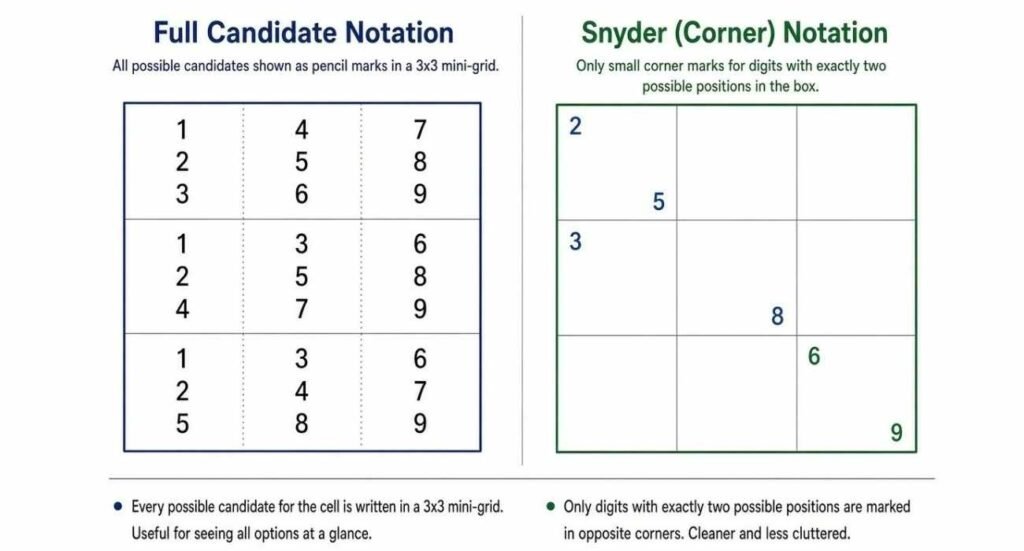
1. Full Candidate Notation
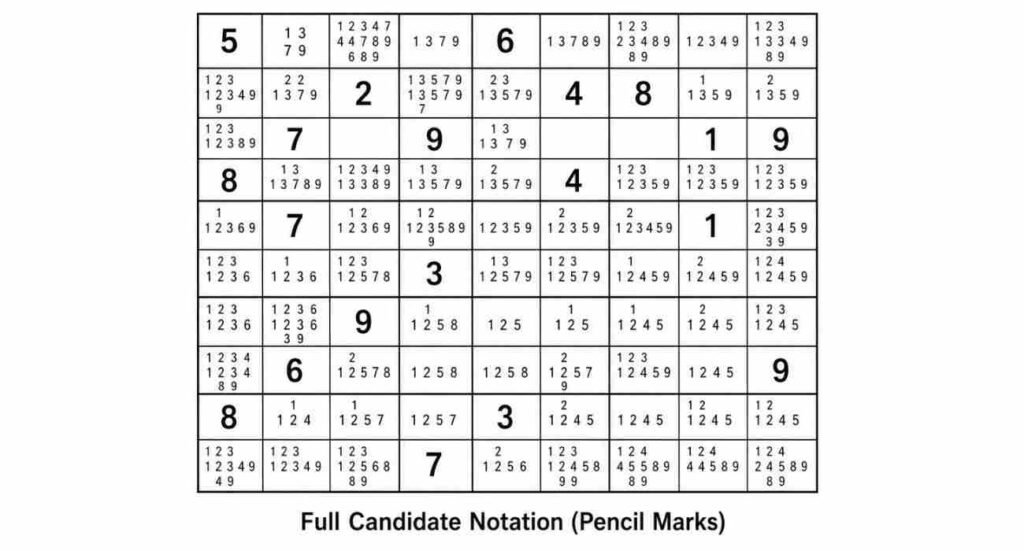
Write every remaining candidate in the cell.
Common layout on paper:
- Top row of the cell: 1 2 3
- Middle row: 4 5 6
- Bottom row: 7 8 9
This is the most complete system and is required for many advanced techniques.
2. Snyder Notation (Corner Notation)
Only mark a candidate when that digit can appear in exactly two cells inside a 3×3 box. Write those two marks in the corners of the cells.
This keeps the grid much cleaner and is preferred by many speed solvers and top competitors (named after puzzle creator Thomas Snyder). It is excellent for spotting locked candidates and box-line reductions, but it does not show the full candidate list needed for some higher techniques.
Many solvers use a hybrid: full candidates on harder puzzles, Snyder-style on medium ones.
How to Keep Pencil Marks Accurate (The Most Important Habit)
Outdated marks cause more mistakes than almost any other factor.
The update rule
Every time you place a confirmed digit:
- Immediately erase that digit from every other empty cell in the same row
- Immediately erase it from every other empty cell in the same column
- Immediately erase it from every other empty cell in the same 3×3 box
Then re-scan those units for new singles or pairs created by the cleanup.
If you skip this step, your notes become lies and will lead you into dead ends.
Common Mistakes That Ruin Pencil Marks
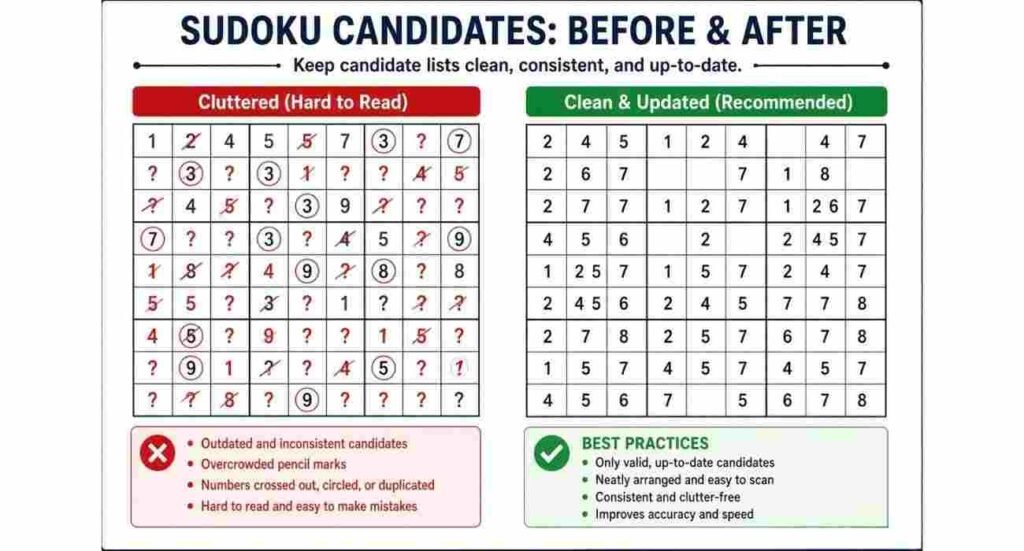
- Marking too early (before exhausting basic singles)
- Forgetting to update after every placement
- Writing marks inconsistently (different positions for the same digit)
- Leaving “stale” candidates that should have been eliminated
- Over-marking easy cells that could have been solved by scanning
- Guessing instead of using the marks to force eliminations
Clean, updated marks beat messy, complete marks every time.
How Pencil Marks Unlock Intermediate and Advanced Techniques
Once candidates are visible, patterns become obvious:
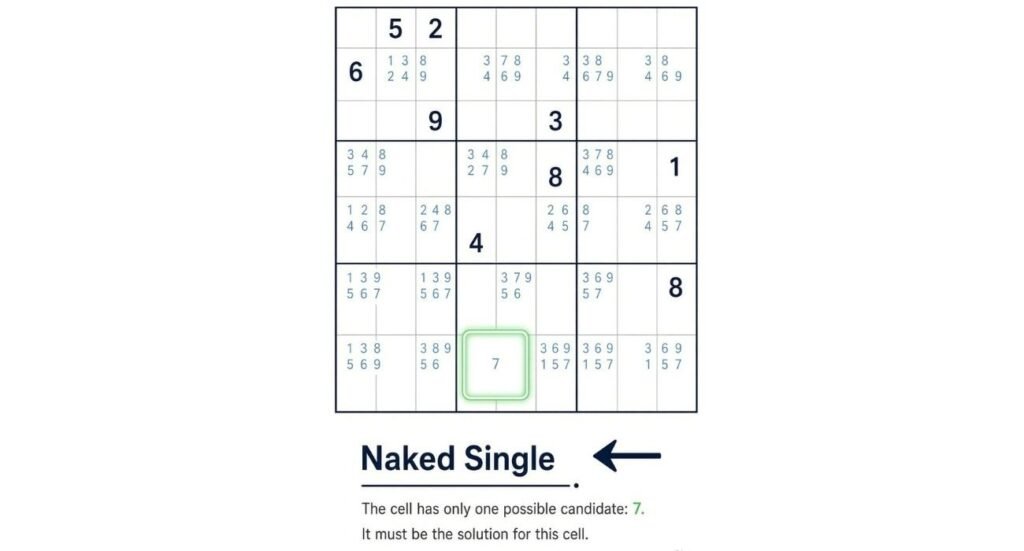
- Naked Single — a cell with only one remaining candidate
- Hidden Single — a candidate that appears in only one cell of a row, column, or box
- Naked Pair — two cells in the same unit that contain exactly the same two candidates → those two digits can be eliminated from the rest of the unit
- Locked Candidates — a candidate confined to one row or column inside a box → it can be eliminated from the rest of that row or column outside the box
- Higher techniques (X-Wing, Swordfish, XY-Wing, etc.) all operate on candidate lists
Accurate pencil marks are the foundation of every technique beyond basic scanning.
Paper vs Digital Pencil Marks
On paper
- Use a sharp pencil and a good eraser
- Keep marks small and consistent in position
- Consider a light grid or larger cells if your handwriting is large
In digital apps / online
Most modern solvers have a dedicated Notes mode.
Advantages:
- Automatic cleanup when you place a digit
- Highlighting of a single candidate across the grid
- Easy toggle between Notes and Normal entry
Practice both so you stay flexible.
Pro Tips for Faster, Cleaner Solving
- Mark only what you need. Not every cell requires full candidates on every puzzle.
- After placing a digit, immediately look for the new singles the cleanup created.
- When stuck, re-check that every mark is still valid — one outdated candidate is often the culprit.
- On very hard puzzles, full candidate lists are usually necessary.
- Combine pencil marks with the 45-rule (each row/column/box sums to 45) for extra eliminations.
Practice Recommendation
The best way to internalize pencil marks is deliberate practice:
- Solve a medium puzzle using only scanning for as long as possible.
- When progress stops, add candidates systematically.
- Force yourself to update after every single placement.
- Repeat on progressively harder grids.
You can practice directly on the interactive Classic Sudoku, Diagonal Sudoku, Killer Sudoku, and Samurai Sudoku boards available on Sudoku Times. Use the Notes feature and watch how quickly patterns appear once candidates are visible.
FAQs on Sudoku Pencil Marks
Q.1: Do I need pencil marks for easy Sudoku?
Ans: Usually no. Easy puzzles are designed to be solved by scanning alone. Marks become useful from medium difficulty upward.
Q.2: Should I mark every empty cell?
Ans: Not always. On medium puzzles many solvers only mark cells with two or three candidates. On hard and expert puzzles, full marking is often the fastest route.
Q.3: What is the difference between pencil marks and candidates?
Ans: They are the same thing. “Pencil marks” is the traditional paper term; “candidates” is the more technical term used in strategy discussions.
Q.4: Can I solve hard Sudoku without pencil marks?
Ans: Technically possible for some people with exceptional working memory, but it is far slower and more error-prone. Virtually all strong solvers use them.
Mastering Sudoku pencil marks is the single biggest leap most players make between struggling with medium puzzles and confidently solving hard and expert ones. Keep your marks accurate, update them ruthlessly, and the rest of the techniques become dramatically easier.
Ready to put this into practice? Open a fresh puzzle on Sudoku Times and start building clean candidate lists. Your solving speed and accuracy will improve faster than almost any other single habit.

Sweta MS is the founder and editor of Sudoku Times. A passionate Sudoku enthusiast and logic puzzle solver for over 12 years, she has solved thousands of puzzles ranging from easy to expert level. Sweta specializes in breaking down advanced solving techniques (X-Wing, Swordfish, XY-Wing and more) into clear, practical guides that help beginners and intermediate players improve faster. Through Sudoku Times, she shares daily puzzles, strategy tutorials and insights into how Sudoku trains the brain. Her goal is to make high-quality Sudoku content accessible, enjoyable and effective for players of all skill levels.