

Discover how Sudoku for stroke recovery trains key cognitive skills: memory, attention, problem-solving & more. Science-backed tips to boost brain rehab after stroke.
Stroke recovery is a challenging journey that often involves rebuilding not just physical strength but also mental capabilities. For many survivors, cognitive impairments like memory lapses, difficulty concentrating, or slowed problem-solving can be frustrating barriers to independence. That’s where simple yet effective brain exercises come in, and Sudoku stands out as a powerful tool. This number-based puzzle isn’t just a fun diversion—it’s a targeted workout for the brain that can aid in retraining key cognitive skills affected by stroke.
In this in-depth guide, we’ll explore how Sudoku supports stroke recovery, the specific cognitive abilities it hones, and why it’s recommended by experts. Backed by scientific insights, we’ll provide practical advice for incorporating it into your rehab routine, complete with tables for quick reference and diagrams to illustrate concepts. Whether you’re a stroke survivor in your recovery phase or a caregiver seeking supportive activities, this post will equip you with the knowledge to use Sudoku effectively. Let’s dive into how this puzzle can help rebuild a sharper, more resilient mind.
The Impact of Stroke on the Brain: Why Cognitive Training Matters
A stroke occurs when blood flow to the brain is interrupted, leading to cell damage in affected areas. Depending on the location and severity, this can result in a range of cognitive deficits. Common issues include aphasia (language problems), apraxia (difficulty with motor planning), and executive dysfunction, where planning and decision-making falter. The prefrontal cortex (PFC), often hit hard, plays a central role in these functions, making targeted exercises crucial for recovery.
Cognitive rehabilitation aims to restore or compensate for these losses through neuroplasticity—the brain’s ability to rewire itself. Activities that challenge the mind encourage new neural connections, potentially improving function over time. Research shows that engaging in mentally stimulating tasks post-stroke can enhance overall recovery, reducing the risk of further decline and boosting quality of life.
For instance, the brain’s “cognitive reserve”—built from lifelong learning—helps buffer stroke effects. Puzzles like Sudoku tap into this by activating underused pathways, promoting healing. Early intervention is key; starting cognitive exercises soon after a stroke can yield better outcomes, as the brain is most plastic in the initial months.
To better understand, here’s a visual of brain regions commonly affected by stroke and activated during puzzle-solving:

This diagram highlights areas like the PFC, which Sudoku stimulates, aiding in executive function recovery.
Sudoku Basics: An Accessible Puzzle for Recovery
Sudoku is a logic puzzle that involves filling a 9×9 grid with numbers 1-9, ensuring no repeats in any row, column, or 3×3 subgrid. It requires no advanced math—just deduction and pattern recognition. Originating from earlier logic games, it became a global hit in the 2000s for its simplicity and scalability.
For stroke survivors, Sudoku’s appeal lies in its adaptability. Beginners can start with 4×4 grids or easy 9×9 versions with many clues, gradually increasing difficulty as skills improve. It’s low-cost (pencil and paper suffice) and portable, making it ideal for home-based rehab. Digital apps offer hints and timers, adding a gentle challenge without overwhelming frustration.
Here’s an example of a beginner-friendly Sudoku grid to illustrate the setup:
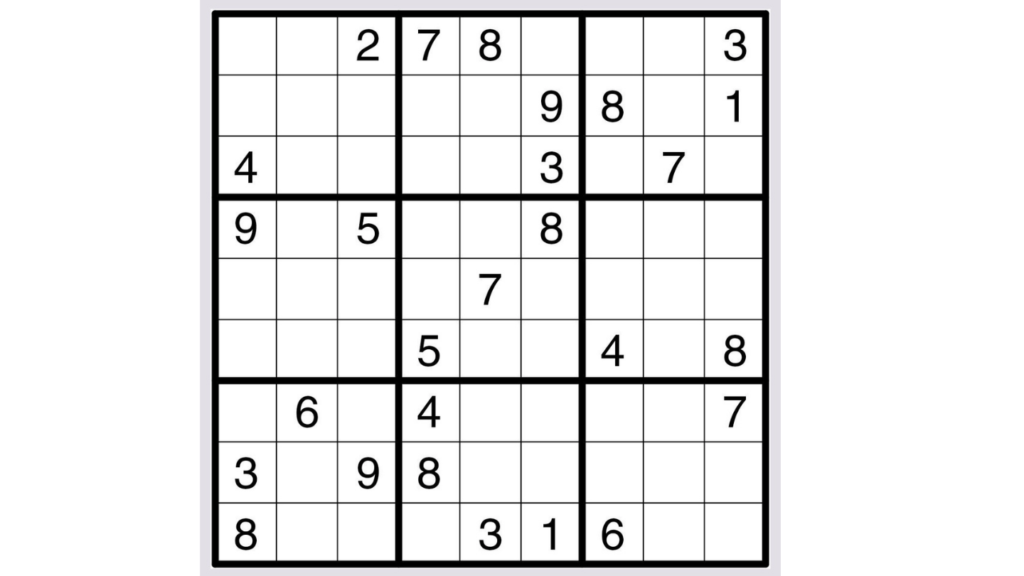
As shown, pre-filled numbers guide the process, training the brain in systematic thinking—perfect for rebuilding post-stroke cognition.
Sudoku for Stroke Recovery: What Cognitive Skills It Trains
Sudoku isn’t random entertainment; it’s a multifaceted brain trainer that targets skills often impaired after a stroke. Let’s break down the primary areas it strengthens.
Working Memory: Holding and Manipulating Information
Working memory—the ability to keep information in mind while using it—is frequently compromised in stroke survivors, leading to forgetfulness in daily tasks. Sudoku demands recalling which numbers are possible in a cell while scanning rows and columns. This constant mental juggling rebuilds memory pathways.
Studies link Sudoku to improved episodic memory and grammatical reasoning in older adults, with benefits extending to preparatory attention and target detection. For stroke patients, this translates to better managing medications or following recipes. For more details on effects of sudoku on working memory visit- Does Sudoku Improve Working Memory? What Neuroscience Actually Says
Attention and Concentration: Sustained Focus Amid Distractions
Post-stroke, attention deficits can make even simple activities exhausting. Sudoku requires scanning the grid for patterns, ignoring irrelevant details, and maintaining focus over time. This hones selective attention and vigilance, crucial for tasks like driving or reading.
Research indicates puzzles enhance attention, with regular players showing brain function akin to 8-10 years younger (Visit- How Sudoku Benefits the Aging Brain (60+, 70+, 80+)). In recovery, this skill helps combat fatigue and improves engagement in therapy sessions.
Problem-Solving and Logical Reasoning: Deductive Thinking
Executive functions, governed by the PFC, involve planning and decision-making—often disrupted by stroke. Sudoku is pure logic: “If 7 is here, what fits there?” This deductive process strengthens reasoning, helping survivors tackle real-world problems like budgeting or navigation.
Neuroimaging shows Sudoku activates the PFC, making it a tool for neurorehabilitation in disorders affecting this area. Survivors report improved strategic thinking after consistent play.
Visual-Spatial Skills: Pattern Recognition and Coordination
Strokes in the right hemisphere can impair spatial awareness. Sudoku’s grid layout trains visual scanning and shape recognition, enhancing hand-eye coordination when using a pencil or touchscreen.
Puzzles boost these skills, aiding in activities like dressing or cooking.
Emotional Regulation and Perseverance: Building Resilience
Beyond cognition, Sudoku fosters patience and a sense of achievement, combating post-stroke depression. Completing a puzzle releases dopamine, motivating continued effort. For details click- Sudoku and Dopamine: Why Solving Sudoku Puzzles Feels Addictive?
This emotional boost enhances agency in rehab, as seen in studies where cognitive self-training increased patient involvement.
To summarize, here’s a table detailing the cognitive skills Sudoku trains and their relevance to stroke recovery:
| Cognitive Skill | How Sudoku Trains It | Stroke Recovery Benefit | Example Daily Application |
|---|---|---|---|
| Working Memory | Retaining number possibilities while filling cells | Reduces forgetfulness | Remembering shopping lists |
| Attention | Scanning grid for patterns without distraction | Improves focus in conversations | Following TV plots |
| Problem-Solving | Logical deduction to place numbers | Enhances decision-making | Planning meals |
| Visual-Spatial | Recognizing grid layouts and alignments | Boosts coordination | Navigating rooms |
| Emotional Regulation | Overcoming challenges for completion | Builds motivation | Persisting in therapy |
This table underscores Sudoku’s targeted impact, making it a staple in cognitive rehab.
Scientific Backing: Evidence of Sudoku for Stroke Recovery
While Sudoku is not a miracle cure, growing scientific evidence positions it as a valuable, accessible tool in post-stroke cognitive rehabilitation. Stroke often damages executive functions controlled by the prefrontal cortex (PFC), including planning, problem-solving, attention, and working memory. Sudoku’s structured logical demands directly target these areas, making it a promising adjunct therapy.
Key Neuroimaging Evidence
Functional near-infrared spectroscopy (fNIRS) studies demonstrate that Sudoku significantly activates the prefrontal cortex — the region most vulnerable in many strokes. During puzzle-solving, players show sustained PFC oxygenation and engagement, similar to targeted cognitive training exercises. This activation helps rebuild neural pathways and supports executive function recovery.
Relevant Clinical Trials and Large-Scale Studies
- ACTIVE Trial (Advanced Cognitive Training for Independent and Vital Elderly): This landmark randomized controlled trial (and its follow-ups) showed that cognitive training programs improve processing speed, memory, and reasoning, with benefits lasting up to 10 years and translating into better daily functioning (e.g., managing finances or medications). Although not exclusively Sudoku-focused, logic-based puzzles were central to the training protocols.
- UK Puzzle Study (19,000+ Adults Aged 50+): Published in the International Journal of Geriatric Psychiatry, researchers found that frequent puzzle solvers (including Sudoku) performed equivalently to people 8–10 years younger on cognitive tests measuring memory, attention, and reasoning. The protective effect was notable even after controlling for education and lifestyle factors.
- SHARE Study Insights: Data from the Survey of Health, Ageing and Retirement in Europe linked regular Sudoku and similar activities to better episodic memory and verbal fluency, particularly benefiting individuals with lower formal education — a group often facing higher post-stroke challenges.
How Sudoku Helps Specific Post-Stroke Deficits
| Deficit Area | How Sudoku Helps | Observed Benefits |
|---|---|---|
| Executive Function | Deductive reasoning & planning | Improved decision-making & problem-solving |
| Working Memory | Holding multiple candidates in mind | Better short-term recall |
| Attention & Concentration | Sustained scanning of grid | Reduced distractibility |
| Processing Speed | Timed solving & pattern recognition | Faster cognitive responses |
| Cognitive Reserve | Building new neural connections | Slower functional decline |
Digital & Adapted Tools for Recovery
Modern digital platforms have adapted Sudoku for rehabilitation:
- CogniFit and NeuroNation offer personalized brain-training programs with Sudoku-like tasks specifically designed for post-stroke patients. These tools adjust difficulty in real-time and track progress on executive functions.
- Simplified 4×4 or 6×6 grids, color-coded variants, and touch-screen versions make it accessible for patients with motor or visual impairments.
- Apps with aphasia-friendly features combine logic puzzles with language recovery exercises.
Important Limitations and Best Practices
Evidence is promising but not definitive. Most studies examine general cognitive training or puzzles broadly rather than Sudoku in isolation. Benefits are strongest when Sudoku is:
- Combined with physical therapy, speech therapy, and medical supervision.
- Introduced gradually with novelty (e.g., progressing to Killer Sudoku or Jigsaw Sudoku).
- Practiced consistently (15–30 minutes, 4–5 days per week).
It is not proven to reverse severe damage or replace professional rehabilitation. Results vary by stroke location, severity, timing of intervention, and patient age. Always consult a neurologist, occupational therapist, or cognitive rehabilitation specialist before starting.
Expert Consensus: Organizations like the American Stroke Association and cognitive neuroscientists increasingly recognize leisure activities like Sudoku as low-cost ways to build cognitive reserve and support long-term recovery. The mental engagement, sense of achievement, and low frustration barrier make it especially suitable for home-based continuation of therapy.
By incorporating Sudoku thoughtfully into a broader recovery plan, many survivors experience meaningful improvements in independence, confidence, and quality of life. It turns a fun daily habit into purposeful neurorehabilitation.
Integrating Sudoku into Stroke Recovery Routines
Starting Sudoku post-stroke? Begin slow. Aim for 10-15 minutes daily, using large-print books or apps with accessibility features.
Here’s a sample weekly plan table:
| Day | Difficulty | Duration | Focus Skill | Tips |
|---|---|---|---|---|
| Monday | Easy | 10 min | Memory | Note possibilities |
| Tuesday | Easy | 15 min | Attention | Time focus periods |
| Wednesday | Medium | 10 min | Problem-Solving | Use hints sparingly |
| Thursday | Easy | 15 min | Visual-Spatial | Draw grids manually |
| Friday | Medium | 20 min | All | Group play for motivation |
| Saturday | Rest | – | – | Review progress |
| Sunday | Varied | 15 min | Emotional | Celebrate completions |
This builds habits without overload.
Pair with therapy: Occupational therapists often recommend puzzles for fine motor skills.
Precautions: If frustration arises, switch to easier levels. Monitor for fatigue—strokes can cause quick exhaustion.
Tips for Maximizing Benefits and Overcoming Hurdles
- Customize Difficulty: Match to current abilities to avoid discouragement.
- Make It Social: Play with family to reduce isolation and add fun.
- Track Improvements: Log completion times to see gains in speed and accuracy.
- Combine with Other Exercises: Alternate with crosswords or chess for broader training.
- Use Tech Aids: Apps provide audio cues for those with visual impairments.
- Seek Professional Guidance: Integrate into a rehab plan supervised by neurologists.
Challenges like hemiparesis? Use one-handed apps or adaptive tools.
Visualize success: Images of survivors engaging in puzzles inspire hope.
Real Life Examples of Sudoku for Stroke Recovery

While individual results vary (and Sudoku works best as part of a broader rehab plan), these cases show tangible progress:
1. David’s Story: Rebuilding Problem-Solving and Logical Thinking After Stroke
David, a stroke survivor who faced major challenges with problem-solving and logical thinking post-stroke, had Sudoku recommended by his therapist as part of his recovery regimen. At first, the puzzles felt overwhelming, but as he persisted with easier grids, they became manageable. Over time, he noticed significant improvements in cognitive abilities, particularly in deductive reasoning and strategic planning. This helped him tackle everyday decisions more confidently, like organizing his schedule or troubleshooting simple home issues. His story illustrates how consistent Sudoku practice can restore executive functions often hit hard by stroke.
(From survivor success stories shared in puzzle and recovery communities.)
2. A Caregiver’s Experience Helping Their Father Post-Stroke
One caregiver shared on a forum how they incorporated varied brain activities, including Sudoku, into their father’s rehab after his stroke. They emphasized that skills transfer—doing Sudoku alongside other tasks (like crosswords or reading) led to broader cognitive gains. The father improved in concentration, number scanning, and logical deduction, which helped with daily mental tasks. The key takeaway: Sudoku provided targeted stimulation without being overwhelming, and combining it with variety prevented plateaus, making recovery feel more well-rounded and motivating.
(This comes from real discussions among family members supporting stroke rehab.)
3. Puzzle Games Like Sudoku for Thinking and Coordination
A stroke survivor described using apps and puzzle games, including Sudoku, as part of their recovery. They noted that puzzle games like Sudoku helped their thinking—improving focus, pattern recognition, and mental flexibility. Starting with simple levels, they built stamina over time, which translated to better handling of conversations, reading, or following instructions without as much mental fatigue. For them, the satisfaction of completing a grid provided motivation during tough days.
(Shared in stroke support communities where people discuss helpful apps and games.)
4. Occupational Therapy Recommendations Leading to Progress
Many occupational therapists recommend Sudoku (often starting with large-print or 4×4 versions from specialized books like Stroke Recovery Toolkit: 4×4 Sudoku) for patients rebuilding logic, reasoning, and confidence. In one highlighted approach, survivors begin with very gentle puzzles and gradually advance to 6×6 or standard 9×9. Patients report milestones like solving harder levels independently, which boosts self-esteem and directly supports real-world skills such as planning meals or managing finances. Therapists note this progression helps with working memory (holding possibilities in mind) and reduces frustration over time.
(From dedicated stroke recovery puzzle resources and therapist-guided programs.)
5. Broader Community Wins with Sudoku in Daily Rehab
In recovery forums and articles, survivors and families frequently mention Sudoku as a “go-to” for cognitive stimulation. One person recovering from cognitive deficits found that regular Sudoku sessions (10-15 minutes daily) sharpened attention and reduced mind-wandering, making it easier to enjoy TV or chat with family. Another noted it as a low-pressure way to build perseverance—small completions created positive momentum, helping combat post-stroke low mood.
These examples align with evidence that Sudoku activates key brain areas (like the prefrontal cortex) and supports neuroplasticity, but the personal “wins” come from persistence and starting small.
To visualize some of these accessible starting points (like beginner 4×4 or large-print grids used in real recovery stories), here are helpful examples:
These show simple setups that many survivors start with to build confidence without frustration.
If you’re incorporating Sudoku into recovery (for yourself or a loved one), track small wins—like finishing an easy puzzle faster each week—and pair it with professional guidance. Real progress often comes from consistency and celebrating those “aha!” moments. Have you tried any puzzles in recovery, or is there a specific cognitive area you’d like more tailored examples for? Keep pushing forward—many have seen real change!
Conclusion: Sudoku as a Pillar of Cognitive Rehab
Sudoku offers a practical, enjoyable way to train cognitive skills vital for stroke recovery—from memory and attention to problem-solving and beyond. Supported by studies showing PFC activation and enhanced function, it’s a low-barrier activity that builds resilience and independence. Start small, stay consistent, and combine with holistic care for the best results. If you’re navigating stroke recovery, embrace Sudoku—your brain’s path to renewal might just be a grid away.
FAQs On Sudoku for Stroke Recovery
Q1- Is Sudoku good for stroke recovery?
Ans- Yes, Sudoku is an excellent, accessible tool for stroke recovery because it specifically targets cognitive domains most often impaired by stroke—working memory, attention, problem-solving, visual-spatial skills, and executive functions—while promoting neuroplasticity through engaging, repeatable mental exercise.
Q2- How does Sudoku help the brain after a stroke?
Ans- Sudoku stimulates the prefrontal cortex and other areas commonly damaged in stroke, encouraging the brain to form new neural connections (neuroplasticity). It retrains working memory, sustained attention, logical reasoning, and visual scanning, which directly address typical post-stroke cognitive deficits.
Q3- What cognitive skills does Sudoku improve after a stroke?
Ans- Sudoku primarily trains working memory, selective and sustained attention, logical deduction and problem-solving, visual-spatial processing, pattern recognition, and perseverance—skills frequently affected by strokes in the prefrontal cortex, parietal lobes, or right hemisphere.
Q4- Can Sudoku help regain memory after a stroke?
Ans- Yes, Sudoku strongly exercises working memory by requiring you to hold multiple number possibilities in mind while scanning the grid, which helps stroke survivors improve short-term recall and information manipulation needed for daily tasks.
Q5- Does Sudoku improve concentration after stroke?
Ans- Absolutely. Post-stroke attention deficits and mental fatigue are common, but Sudoku demands sustained focus and the ability to ignore distractions while scanning for patterns, gradually rebuilding concentration capacity.
Q6- Is Sudoku recommended by therapists for stroke rehabilitation?
Ans- Many occupational therapists and neuropsychologists recommend Sudoku (or similar logic puzzles) as part of cognitive rehabilitation programs because it is graded in difficulty, motivating, and specifically activates executive function networks damaged by stroke.
Q7- How soon after a stroke can you start playing Sudoku?
Ans- As soon as the medical team clears you for cognitive activity—often within days to weeks for ischemic strokes—starting with very easy grids or 4×4 versions. Early cognitive stimulation takes advantage of the brain’s highest plasticity period in the first 3–6 months.
Q8- How often should stroke survivors do Sudoku for best results?
Ans- 10–20 minutes daily or 5–6 days per week is ideal. Short, regular sessions prevent fatigue while providing consistent stimulation; gradually increase difficulty and duration as cognitive stamina improves.
Q9- What scientific evidence supports Sudoku for stroke recovery?
Ans- Functional near-infrared spectroscopy (fNIRS) studies show Sudoku significantly activates the prefrontal cortex. Large-scale cognitive training trials (including the ACTIVE study) and research on number puzzles demonstrate lasting improvements in memory, reasoning, and daily function similar to those needed after stroke.
Q10- Can Sudoku help with aphasia or speech recovery after stroke?
Ans- While Sudoku is not a direct language exercise, it improves attention, working memory, and executive control—skills that support language rehabilitation and help compensate for aphasia by strengthening overall cognitive efficiency.
Q11- Is Sudoku helpful for right-hemisphere stroke patients with spatial problems?
Ans- Yes, very much. Right-hemisphere strokes often cause visual-spatial deficits and neglect; the structured grid of Sudoku retrains systematic visual scanning, spatial organisation, and pattern recognition in an engaging way.
Q12- Are there special Sudoku apps or websites recommended for stroke patients?
Ans- Yes—apps with large numbers, hint buttons, colour options, one-handed mode, and progress tracking (such as Sudoku.com, SudokuTimes.com, Brain Training by NeuroNation, or CogniFit) are particularly helpful for survivors with motor, visual, or cognitive limitations.

Sweta MS is the founder and editor of Sudoku Times. A passionate Sudoku enthusiast and logic puzzle solver for over 12 years, she has solved thousands of puzzles ranging from easy to expert level. Sweta specializes in breaking down advanced solving techniques (X-Wing, Swordfish, XY-Wing and more) into clear, practical guides that help beginners and intermediate players improve faster. Through Sudoku Times, she shares daily puzzles, strategy tutorials and insights into how Sudoku trains the brain. Her goal is to make high-quality Sudoku content accessible, enjoyable and effective for players of all skill levels.