

Sudoku solving techniques are the key to cracking any puzzle, whether you’re a complete beginner or tackling expert-level grids that seem impossible. If you’ve ever searched “how to solve Sudoku puzzles,” “advance Sudoku strategies,” or “Sudoku tips for hard puzzles,” this complete Sudoku solving techniques list is your ultimate resource. In this 3500+ word guide, you’ll discover every proven method—from basic scanning to sophisticated patterns like X-Wing, Swordfish, XY-Wing, and forcing chains—so you can solve Sudoku puzzles faster, smarter, and with zero guessing.
Sudoku isn’t about math; it’s pure logic. Millions play daily for its brain-boosting benefits: sharper concentration, better memory, stress relief, and that satisfying “aha!” moment. Whether you’re new to Sudoku or aiming to dominate daily challenges on apps or newspapers, learning these Sudoku techniques will transform your game. We’ll cover the full Sudoku solving techniques list categorized by difficulty, with step-by-step explanations, real examples, tables, and custom illustrations. By the end, you’ll have a systematic approach for any difficulty level.
Let’s dive in and master Sudoku solving techniques once and for all.
Sudoku Rules and Basics: The Foundation of Every Solve
Before any Sudoku technique, master the rules. A standard 9×9 Sudoku grid divides into nine 3×3 boxes (regions). The goal: Fill every empty cell with numbers 1-9 so each row, column, and 3×3 box contains each digit exactly once. No repeats allowed.
That’s it—no sums, no tricks beyond logic. Easy puzzles have many givens (pre-filled cells); hard ones have few. The secret? Systematic elimination of candidates (possible numbers) using pencil marks.
Pro Tip: Always start with pencil marks. Write tiny candidates in empty cells to track possibilities. This unlocks every advanced Sudoku strategy.
Essential Tools for Sudoku Solving Techniques
All Sudoku techniques rely on candidates. Use a pencil (or app eraser) to note possibilities. As you apply techniques, cross off impossible numbers. This visual tracking separates beginners from pros.
Many apps (like Sudoku.com or expert solvers in 2026) auto-generate candidates, but learning manually builds real skill.
Beginner Sudoku Solving Techniques: Build Your Foundation
Start here for easy and medium puzzles. These Sudoku tips solve 80% of grids quickly.
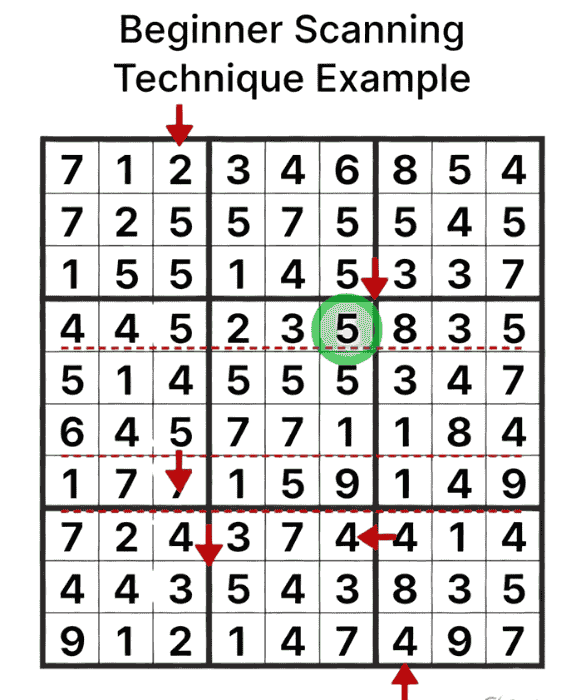
1. Scanning / Cross-Hatching (The Most Basic Sudoku Strategy)
Scan rows, columns, and boxes for missing numbers. Look for “naked” opportunities where a number fits only one spot.
How it works: Pick a number (start with 1-9 that appear often). Check its placements in rows/columns/boxes. Eliminate where it’s blocked.
Step-by-step example:
- Number 5 appears in row 1 and box 1. Scan the column where it must go.
- Cross-hatch: Draw mental lines through occupied rows/columns in a box.
This technique shines early and combines with others for “how to solve Sudoku puzzles” fast.
2. Naked Singles (Obvious Singles)
A cell with only one possible candidate left? Fill it immediately. This is the simplest yet most powerful beginner Sudoku solving technique.
Logic: All other numbers in its row, column, or box eliminate alternatives.
Example: Cell has candidates {2,5,8}. But 2 and 8 appear elsewhere in the row—only 5 remains. Place it and update candidates.
Repeat until no more singles.
3. Hidden Singles
The number appears as a candidate in multiple cells, but only one cell in the unit (row/column/box) can take it.
How to spot: Scan a unit for a number that shows up in only one cell’s candidates.
Pro Tip: Hidden singles often appear after basic scanning. They unlock chains of naked singles.
| Technique | Difficulty | What It Does | Best For |
|---|---|---|---|
| Scanning | Beginner | Eliminates via lines | Easy puzzles |
| Naked Singles | Beginner | Fills obvious cells | Any level |
| Hidden Singles | Beginner | Finds hidden placements | Medium puzzles |
These three beginner Sudoku techniques often solve entire easy puzzles.
Intermediate Sudoku Strategies: Level Up Your Game
When basics stall, apply these. They eliminate multiple candidates at once.
4. Naked Pairs, Triples, and Quads
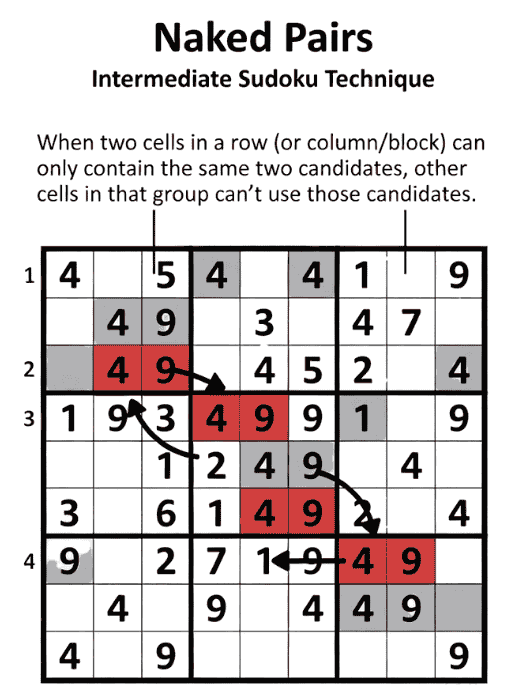
Two (or more) cells in a unit share exactly the same two (or three/four) candidates. Those numbers can’t go anywhere else in the unit.
Example: Cells A and B both have only {3,7}. Eliminate 3 and 7 from all other cells in the row.
Triples/Quads: Same logic for three or four cells. Rare but powerful.
5. Hidden Pairs and Triples
Two numbers appear only in two cells within a unit (even if cells have extra candidates). Those cells must contain those numbers—eliminate extras.
6. Pointing Pairs / Triples (Locked Candidates)
A candidate appears in two or three cells of a box, all in the same row (or column). It “points” to that row/column—eliminate it from the rest of the row/column outside the box.
Box/Line Reduction: The reverse—candidates locked in a line within a box.
These intermediate Sudoku techniques clear clutter fast.
Advanced Sudoku Techniques: Tackle Hard Puzzles
These are the “wow” Sudoku solving techniques for tough grids. Master them for newspapers’ “hard” or “expert” sections.
7. X-Wing (Basic Fish Pattern)
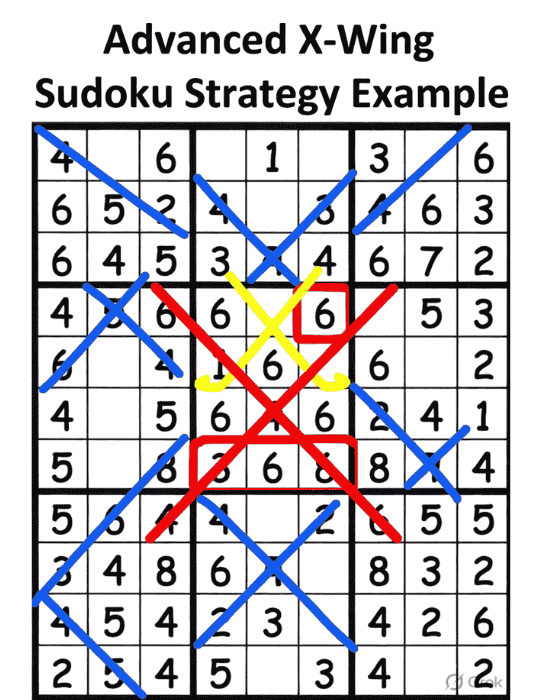
Two rows (or columns) each have exactly two candidates for a number, aligned in the same two columns (or rows). Forms an “X” rectangle.
Logic: The number must be in the four corners. Eliminate it from other cells in those two columns (or rows).
Classic use case: Digit 4 in rows 3 and 7, columns 2 and 8 only. Remove 4s elsewhere in columns 2 and 8.
X-Wing is one of the most common advanced Sudoku strategies.
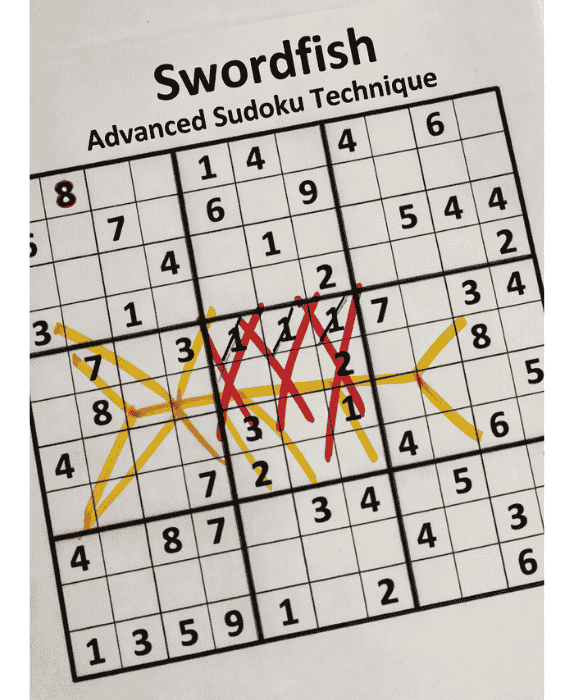
8. Swordfish
Extension of X-Wing to three rows and three columns. The candidate appears in 2-3 positions per row, aligned across three columns.
Logic: Eliminate the digit from other cells in those three columns.
Swordfish solves many “evil” puzzles when X-Wing isn’t enough.
9. Jellyfish (and Larger Fish)
Four rows/columns with aligned candidates. Rare but follows the same elimination logic. Great for extreme puzzles.
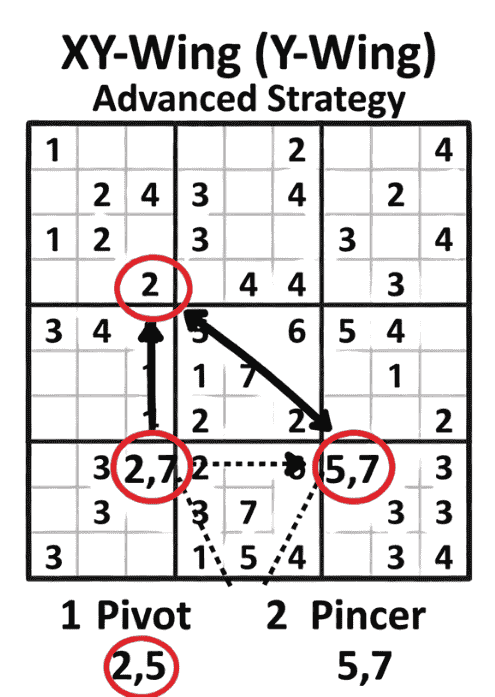
10. XY-Wing (Y-Wing)
Three cells: One “pivot” with two candidates (X,Y), plus two “pincers” each sharing one with the pivot (X,Z and Y,Z).
Logic: If pivot is X, one pincer is Z; if Y, the other is Z. Thus, Z is eliminated from cells seen by both pincers.
XY-Wing is a favorite advanced Sudoku technique because it’s visual and frequent.
11. XYZ-Wing
Similar to XY-Wing but pivot has three candidates (X,Y,Z). Pincers have X,Z and Y,Z. Eliminates Z from cells seen by all three.
12. Unique Rectangles (Type 1-4)
Four cells in two rows, two columns, two boxes forming a rectangle with identical two candidates. Type 1: If three cells have extra candidates but the fourth doesn’t, avoid deadly pattern by eliminating.
Unique rectangles prevent “multiple solutions” traps in proper puzzles.
Expert Sudoku Solving Techniques: For the Toughest Puzzles
These handle the rarest stuck situations.
13. Coloring (Simple and Multi-Color)
Assign colors (e.g., red/blue) to candidates of one number in alternating chains. Contradictions eliminate colors.
Advanced coloring: Track multiple colors for complex eliminations.
14. Forcing Chains and Bidirectional Chains
Create “if this then that” chains between cells. A contradiction or common outcome eliminates candidates.
Nice Loops / Alternating Inference Chains: More systematic version.
15. Almost Locked Sets (ALS) and Death Blossoms
Complex groupings where nearly locked sets interact. High-level but incredibly powerful.
| All Sudoku Techniques Summary | Difficulty Level | Key Benefit | Frequency in Puzzles |
|---|---|---|---|
| Scanning & Singles | Beginner | Quick placements | Very High |
| Naked/Hidden Pairs/Triples | Intermediate | Batch eliminations | High |
| Pointing Pairs / Box-Line | Intermediate | Locked candidate removal | Medium |
| X-Wing / Swordfish / Jellyfish | Advanced | Fish pattern eliminations | Medium |
| XY-Wing / XYZ-Wing | Advanced | Wing eliminations | High in hard puzzles |
| Unique Rectangles | Advanced | Prevents invalid patterns | Medium |
| Coloring & Chains | Expert | Complex logic chains | Low but decisive |
| ALS & Advanced Patterns | Expert | Ultimate stuck-solvers | Very Low |
This table gives you the complete Sudoku solving techniques list at a glance—perfect for quick reference.
How to Apply Sudoku Techniques in Order: Your Winning System
- Scan & fill all singles (naked + hidden).
- Pencil marks everywhere.
- Intermediate pairs/triples + pointing.
- Look for fish (X-Wing → Swordfish).
- Wings (XY/XYZ).
- Chains & coloring if stuck.
Always re-scan after each placement—new singles appear!
General Tips to Improve at Sudoku Solving Techniques
- Practice daily: Start easy, progress to hard.
- Time yourself but focus on accuracy first.
- Avoid guessing—every solve should be 100% logical.
- Use apps with hints only after trying yourself (Sudoku Coach apps in 2026 are excellent).
- Join communities: Reddit r/sudoku for technique discussions.
- Common mistakes: Forgetting to update candidates, missing hidden singles, over-relying on one technique.
Practice Resources and Next Steps
Print free puzzles from sites like Sudoku.org or use apps with technique trainers. Track which Sudoku techniques you master weekly.
Conclusion: Become a Sudoku Master Today
This complete Sudoku solving techniques list—from beginner scanning to expert chains—equips you to solve any puzzle confidently. Consistent practice turns these strategies into second nature. Next time you see a tough grid, you’ll know exactly which advanced Sudoku strategy to deploy.
Bookmark this guide, share it with friends, and start applying these techniques today. Your brain (and solving speed) will thank you!
FAQs on Sudoku Solving Techniques
Q.1- What are the basic Sudoku solving techniques for beginners?
Ans- The basic Sudoku solving techniques for beginners are scanning (cross-hatching), naked singles, and hidden singles. These methods help quickly identify obvious placements and eliminate impossible candidates using row, column, and 3×3 box rules.
Q.2- How do you solve a Sudoku puzzle step by step?
Ans- To solve a Sudoku puzzle step by step, first apply scanning to place obvious numbers, then fill naked and hidden singles. Update pencil marks after each placement. Move to naked/hidden pairs and triples for intermediate puzzles, followed by X-Wing, Swordfish, and XY-Wing for harder grids. Always re-scan after every change.
Q.3- What is the best Sudoku solving technique for hard puzzles?
Ans- The best Sudoku solving techniques for hard puzzles are X-Wing, Swordfish, XY-Wing (Y-Wing), and forcing chains. These advanced patterns allow logical eliminations when basic methods no longer work, without any guessing.
Q.4- Do you need to guess when solving Sudoku?
Ans- No, you never need to guess when solving Sudoku. Every valid Sudoku puzzle has a unique logical solution that can be reached using proper Sudoku solving techniques such as singles, pairs, fish patterns, wings, and chains.
Q.5- What is an X-Wing in Sudoku?
Ans- An X-Wing in Sudoku is an advanced technique where a candidate number appears in exactly two positions in two different rows (or columns) that align in the same two columns (or rows), forming a rectangle. This pattern allows elimination of that candidate from other cells in the two columns (or rows).
Q.6- What is the difference between naked singles and hidden singles in Sudoku?
Ans- A naked single occurs when a cell has only one possible candidate left. A hidden single occurs when a number can only fit in one specific cell within a row, column, or box, even if that cell has multiple candidates. Both are fundamental Sudoku solving techniques.
Q.7- How does the Swordfish technique work in Sudoku?
Ans- The Swordfish technique works when a candidate appears in two or three positions across three rows (or columns) and aligns in the same three columns (or rows). This fish pattern allows safe elimination of that candidate from the remaining cells in those three columns (or rows).
Q.8- What is XY-Wing in Sudoku solving?
Ans- XY-Wing (also called Y-Wing) is an advanced Sudoku technique involving three cells: a pivot cell with two candidates (X,Y) and two pincer cells sharing one candidate each with the pivot. It eliminates the common third candidate (Z) from any cell seen by both pincers.
Q.9- What are pencil marks in Sudoku and why are they important?
Ans- Pencil marks in Sudoku are the small candidate numbers written in empty cells to track all possible values. They are important because they make it easier to spot naked singles, hidden singles, pairs, triples, and advanced patterns like X-Wing or XY-Wing.
Q.10- How many Sudoku solving techniques are there?
Ans- There are dozens of Sudoku solving techniques, but the most important ones include scanning, naked/hidden singles, naked/hidden pairs and triples, pointing pairs, X-Wing, Swordfish, Jellyfish, XY-Wing, XYZ-Wing, Unique Rectangles, coloring, and forcing chains.
Q.11- What is a naked pair in Sudoku?
Ans- A naked pair in Sudoku occurs when two cells in the same row, column, or 3×3 box share exactly the same two candidates. Those two numbers can be eliminated from all other cells in that unit, making it a powerful intermediate Sudoku solving technique.
Q.12- Can Sudoku be solved without guessing?
Ans- Yes, Sudoku can always be solved without guessing if it is a valid puzzle with a unique solution. Proper application of logical Sudoku solving techniques such as singles, fish patterns, wings, and chains guarantees a complete solution.
Q.13- What is the easiest way to solve Sudoku puzzles?
Ans- The easiest way to solve Sudoku puzzles is to start with scanning for obvious placements, then repeatedly look for naked singles and hidden singles while maintaining accurate pencil marks. This beginner-friendly approach solves most easy and medium puzzles quickly.
Q.14- What are pointing pairs in Sudoku?
Ans- Pointing pairs (or locked candidates) occur when a candidate number appears only in one row (or column) inside a 3×3 box. This allows elimination of that candidate from the rest of the row (or column) outside the box, serving as a useful intermediate technique.
Q.15- How long does it take to master Sudoku solving techniques?
Ans- It usually takes 2 to 6 weeks of daily practice to master basic and intermediate Sudoku solving techniques, and 2 to 4 months to become comfortable with advanced techniques like X-Wing, Swordfish, and XY-Wing, depending on practice consistency.

SwetaMS is the founder and editor of Sudoku Times, a leading blog dedicated to Sudoku puzzles, logical reasoning, and brain training. With a deep passion for analytical thinking and problem-solving, Sweta curates engaging Sudoku challenges, expert solving techniques, and thoughtful insights for puzzle enthusiasts of all levels.