

If you’ve ever completed a Sudoku puzzle and wondered whether another solution was possible, you’re not alone. Behind the simple 9×9 grid lies one of the most remarkable combinatorial achievements in mathematics. The question “How many valid Sudoku solutions exist?” has a precise and jaw-dropping answer that continues to fascinate solvers and mathematicians alike.
In this guide, we reveal the exact number, explore how it was calculated, examine related breakthroughs like the minimum number of clues, and explain why this massive figure makes Sudoku endlessly engaging.
How Many Valid Sudoku Solutions Exist?: The Exact Number
Mathematicians have calculated that there are exactly 6,670,903,752,021,072,936,960 valid completed Sudoku grids.
This equals 6.67 sextillion (or 6.67 × 10²¹ in scientific notation).
To truly appreciate this scale:
- A million is 1,000,000 (10⁶)
- A billion is 1,000,000,000 (10⁹)
- A trillion is 1,000,000,000,000 (10¹²)
- A sextillion is 1 followed by 21 zeros (10²¹)
If you could examine one million Sudoku grids every second, it would still take approximately 211 million years to review them all. For perspective, modern humans have existed for only about 300,000 years, and the universe itself is roughly 13.8 billion years old.
What Exactly Counts as a Valid Sudoku Solution?
A completed 9×9 Sudoku grid is valid only when it satisfies three strict rules simultaneously:
- Each row contains the digits 1 through 9 exactly once.
- Each column contains the digits 1 through 9 exactly once.
- Each of the nine 3×3 subgrids (boxes) contains the digits 1 through 9 exactly once.
These overlapping constraints create an extraordinarily restrictive environment. While the total ways to fill a 9×9 grid without rules is 81! (an astronomically larger number), the Sudoku rules narrow it down to this precise count of 6.67 sextillion valid completions.
How Mathematicians Discovered This Number
The definitive count came in 2005 from German mathematician Bertram Felgenhauer and British mathematician Frazer Jarvis. Their work combined mathematical insight with computational power.
Instead of brute-force checking (which would have been impossible), they:
- Reduced the problem using Sudoku’s natural symmetries (bands, stacks, and permutations).
- Systematically enumerated possibilities starting from the top rows.
- Applied advanced pruning techniques to eliminate invalid paths early.
Their published result — 6,670,903,752,021,072,936,960 — has been independently verified multiple times and remains the accepted exact figure.
✍️Try Your hands ✍️
Try today’s free Daily Sudoku Challenge on SudokuTimes.com — fresh puzzle every day, with hints, timer and progress tracking!
Symmetries and Essentially Different Grids
Although there are 6.67 sextillion valid grids, many are mathematically equivalent under transformations such as:
- Relabeling the digits (e.g., swapping every 1 with a 7).
- Reordering rows within the same band of three rows.
- Reordering columns within the same stack.
- Rotating or reflecting the entire grid.
When these equivalent versions are grouped, the number of fundamentally distinct Sudoku grids reduces to approximately 5.47 billion. This is still an enormous library of unique patterns.
Solution Grids vs. Actual Playable Sudoku Puzzles
It’s important to distinguish between solution grids (fully completed valid boards) and Sudoku puzzles (partially filled grids with exactly one logical solution).
The number of possible puzzles is vastly larger because clues can be removed in countless combinations while maintaining uniqueness and a logical solving path. No one has computed the exact total number of valid puzzles — it may be effectively uncountable for practical purposes.
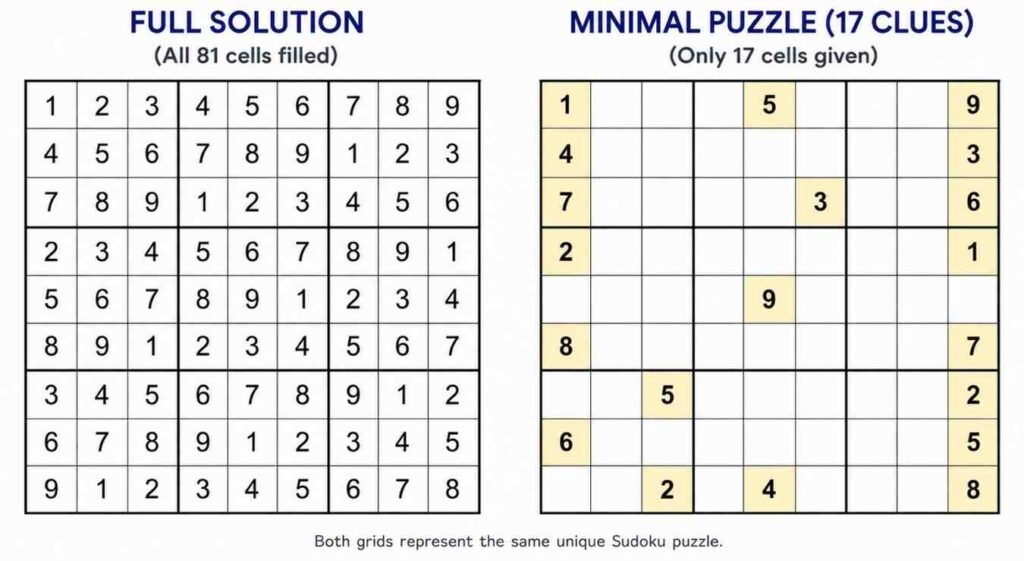
The Minimum Number of Clues for a Unique Solution: 17
Another landmark result answers a related question: What is the fewest clues a Sudoku puzzle can have while still guaranteeing exactly one solution?
The answer is 17.
In 2012, exhaustive computer searches proved that no valid 16-clue puzzle exists with a unique solution. Thousands of 17-clue “minimal” puzzles have since been discovered, and they often rank among the most challenging and elegant puzzles available.
These minimal puzzles demonstrate the delicate balance required within the 6.67 sextillion solution space.
Mind-Blowing Scale Comparisons
| Activity | Time to Cover All 6.67 Sextillion Grids |
|---|---|
| Solving 1 puzzle per minute | Approximately 12.7 quadrillion years |
| Checking 1 million grids per second | About 211 million years |
| Age of the Universe | 13.8 billion years (you would need ~15,000 universes) |
Why This Matters for Everyday Sudoku Solvers
This enormous number explains several things Sudoku lovers experience:
- Endless freshness — New puzzles feel genuinely different every time.
- Rich difficulty range — From gentle morning warm-ups to diabolical challenges.
- Deep logical satisfaction — Every solve carves a unique path through an unimaginably vast space.
- Appreciation for creators — Puzzle designers carefully navigate this space to craft fair, engaging challenges.
Conclusion
How many valid Sudoku solutions exist? Exactly 6,670,903,752,021,072,936,960 — or 6.67 sextillion.
This single fact transforms Sudoku from a simple number puzzle into a gateway to profound mathematical beauty. The next time you fill in that last cell with satisfaction, remember you’ve navigated just one tiny corner of an immense combinatorial universe.
Sudoku’s rules may be simple, but the possibilities they create are boundless. That’s what makes it one of the world’s most enduring and addictive logic puzzles.
FAQs on How many valid Sudoku solutions exist
Q.1: How many valid Sudoku solutions exist?
Ans: There are exactly 6,670,903,752,021,072,936,960 valid completed Sudoku grids — that’s 6.67 sextillion.
Q.2: Who calculated this number and when?
Ans: Mathematicians Bertram Felgenhauer and Frazer Jarvis calculated the exact number in 2005 using advanced computational techniques and symmetry reductions.
Q.3: What is the difference between a Sudoku solution grid and a Sudoku puzzle?
Ans: A solution grid is a completely filled valid board. A puzzle is a partially completed grid that has exactly one unique logical solution.
Q.4: What is the minimum number of clues required for a valid Sudoku puzzle?
Ans: The minimum is 17 clues. It has been proven that no 16-clue puzzle can have a unique solution.
Q.5: Are all 6.67 sextillion grids unique?
Ans: No. Many are mathematically equivalent through rotations, reflections, digit relabeling, or row/column permutations. When accounting for these symmetries, there are about 5.47 billion essentially different grids.
Q.6: Why is this huge number important for Sudoku players? A: It explains why Sudoku never feels repetitive. Every puzzle offers a fresh logical journey within an almost infinite mathematical space.
Q.7: Can modern computers generate all possible Sudoku grids?
Ans: No. Even today’s supercomputers cannot enumerate the full 6.67 sextillion solutions in any reasonable time. They can, however, generate high-quality puzzles on demand.
Q.8: Does the number of solutions differ for Sudoku variants like Killer Sudoku?
Ans: Yes. Standard 9×9 Sudoku has 6.67 sextillion solutions. Variants with additional constraints usually have fewer valid grids.
Q.9: How long would it take a human to solve every possible Sudoku grid?
Ans: If you solved one puzzle per minute without stopping, it would take approximately 12.7 quadrillion years — vastly longer than the age of the universe.
Q.10: Is knowing this mathematical fact helpful for becoming a better Sudoku solver?
Ans: Yes, indirectly. It builds deeper appreciation for the puzzle’s complexity and encourages patience and systematic thinking when solving hard puzzles.
Q.11: Where can I find 17-clue minimal Sudoku puzzles?
Ans: Many advanced Sudoku websites and apps offer collections of minimal 17-clue puzzles. They are among the most challenging and elegant puzzles available.
Q.12: Has the 6.67 sextillion number ever been disputed?
Ans: No. The figure has been independently verified multiple times since 2005 and is widely accepted in the mathematical community.

Sweta MS is the founder and editor of Sudoku Times. A passionate Sudoku enthusiast and logic puzzle solver for over 12 years, she has solved thousands of puzzles ranging from easy to expert level. Sweta specializes in breaking down advanced solving techniques (X-Wing, Swordfish, XY-Wing and more) into clear, practical guides that help beginners and intermediate players improve faster. Through Sudoku Times, she shares daily puzzles, strategy tutorials and insights into how Sudoku trains the brain. Her goal is to make high-quality Sudoku content accessible, enjoyable and effective for players of all skill levels.
Pingback: Why Some Sudoku Puzzles Have Multiple Solutions And How to Fix It - Sudoku Times