

Sudoku remains one of the world’s most popular logic puzzles, offering endless satisfaction through deduction. Yet, not every grid leads to a single, definitive answer. Some puzzles allow multiple valid completions, leaving solvers frustrated or second-guessing their work.
In this detailed guide, we break down why some Sudoku puzzles have multiple solutions. We’ll cover the underlying mathematics, real examples, detection methods, creation techniques, common myths and practical advice.
What Makes a Sudoku Puzzle “Proper”?
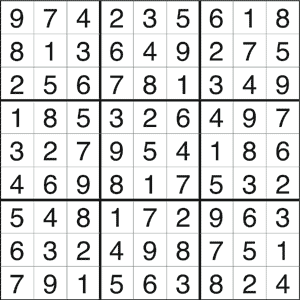
A proper (or well-formed) Sudoku has exactly one unique solution. This uniqueness defines the genre and enables pure logical solving without ambiguity or heavy guessing.
Published puzzles in books, apps and sites almost always follow this standard. Multiple solutions turn it into something else—a partial Latin square or an incomplete constraint satisfaction problem.
Key Traits of Proper Sudokus
- Unique Completion: Only one grid satisfies all rules.
- Logic-Driven: Solvable via scanning, singles, pairs, advanced patterns (X-Wing, Swordfish, etc.).
- Clue Efficiency: Balances difficulty with minimality—famous 17-clue examples prove it’s possible with very few givens.
Non-proper puzzles fail this test, often due to design oversights.
Why Do Some Sudoku Puzzles Have Multiple Solutions?
The core issue is insufficient or ineffective constraints. Standard Sudoku rules (1-9 unique in every row, column, and 3×3 box) must pin down exactly one arrangement. With gaps, alternatives emerge.
Primary Reasons:
- Too Few Clues: This is the most common cause. An completely empty 9×9 Sudoku grid has approximately 6.67 × 10²¹ possible valid completions. Each added clue reduces the possibility space, but if too many cells remain empty, the remaining constraints are not strong enough to force a single solution. For example, puzzles with 16 or fewer clues have been mathematically proven to always allow multiple solutions. Even puzzles with 20–30 clues can suffer if the given numbers are clustered in one area of the grid, leaving other regions under-constrained and open to different valid fillings.
- Symmetrical or Redundant Placements: Even when a puzzle has a decent number of clues, poor distribution can create “holes” in the logic. A classic example is interchangeable pairs or groups: two cells that can swap two digits (like 4 and 7) without violating any row, column, or box rules elsewhere. Symmetrical clue placement often exacerbates this by mirroring possibilities across the grid. Redundant clues (ones that don’t add new information) fail to eliminate these alternatives, allowing multiple complete solutions that all obey the basic Sudoku rules.
- Generation Errors: Modern Sudoku puzzles are frequently created using automated software. While efficient, these generators occasionally produce non-unique grids if the uniqueness-checking algorithm is skipped, poorly implemented, or interrupted. Human publishers may also introduce errors during editing or formatting. Without rigorous post-generation validation (running a multi-solution counter), these flawed puzzles make it into newspapers, books, or apps. This is why some solvers occasionally discover two different answers that both seem correct.
- Intentional Multi-Solution Designs: In standard classic Sudoku, this is rare and usually considered a mistake. However, some puzzle creators intentionally design grids with multiple solutions for specific purposes—such as advanced training exercises, “find all solutions” challenges, or experimental variants. These are more common in non-traditional formats or when the goal is to explore the mathematics of constraint satisfaction rather than provide a single logical path.
Even grids that appear reasonably filled (20-30 clues) can have multiples if the clues are poorly distributed—concentrated in one corner while leaving large empty regions that allow combinatorial freedom. This is why professional puzzle setters always verify uniqueness thoroughly before publication.
Understanding these reasons helps solvers diagnose issues faster and creators build better puzzles. For instance, an empty grid has over 6.67 × 10²¹ possible solutions (For details see How Many Valid Sudoku Solutions Exist?). Adding clues progressively reduces possibilities until only one remains—if done correctly.
The Mathematics Behind Sudoku Uniqueness
Sudoku draws from Latin squares, combinatorics and graph coloring. Each completed grid is one of billions of valid fillings, but clues constrain it to one.
Proven Minimum Clues: 17
Exhaustive searches (e.g., Gary McGuire et al., 2012) established that 17 is the absolute minimum for a unique 9×9 Sudoku. 16 clues always yield multiples. Thousands of 17-clue examples exist; none with fewer.
Distinct Digits Rule
For rank-n Sudoku (n=3 for standard), clues must use at least n²-1 = 8 distinct digits. With 7 or fewer, missing digits can swap freely, creating multiples.
This explains why ultra-sparse puzzles fail uniqueness.
Clue Count vs. Solution Likelihood
| Clue Count | Typical Outcome | Example/Notes |
|---|---|---|
| 0 | ~6.67 × 10²¹ | Fully empty grid |
| ≤16 | Always multiple | Mathematically impossible for unique |
| 17 | Possible unique | Minimum proven; many known examples |
| 18-25 | Often unique (easy) | Common in casual puzzles |
| 26-35 | Usually unique (medium) | Balanced difficulty |
| 36-40+ | Unique if designed well | Maximal minimal puzzles (hard) |
Examples of Puzzles with Multiple Solutions
Simple illustration: Suppose two empty cells in positions that allow swapping 4 and 7 without rule breaks elsewhere. Two (or more) solutions result.
A classic culprit is the Unique Rectangle (UR) or “Deadly Pattern”: Four cells in two rows/columns/boxes holding exactly two candidate pairs (e.g., 1/2 in a rectangle). Without extra clues, they can flip, yielding two solutions. Solvers use UR Type 1-4 techniques assuming uniqueness to eliminate.
In practice, newspaper errors or bad generators produce these. One real-world case: Solvers find two completions and check the answer key—mismatch!
For contrast, 17-clue minimal puzzles (like those studied in Numberphile videos) force uniqueness through clever placement.
How to Detect If a Sudoku Has Multiple Solutions
- Solve Manually: Reach a point with two viable paths? Test both to completion.
- Online Solvers: Tools with “Solution Count” (e.g., SudokuWiki, Andrew Stuart’s solver) use backtracking to enumerate.
- Programming: Implement recursive backtracking in Python/Java—find one solution, then search for a second.
- Advanced Patterns: BUG (Bivalue Universal Grave) or extended rectangles signal non-uniqueness.
Solving Techniques Relying on Uniqueness
Many strategies implicitly assume one solution:
- Uniqueness Rectangles: “This can’t happen, or there’d be multiples.”
- BUG+1: Identifies deadly states.
- Forcing Chains: Branching assumes the puzzle resolves uniquely.
In multiple-solution puzzles, logic may stall, forcing guesses.
How to Create Unique Sudoku Puzzles (Best Practices)
- Generate Full Grid: Use dancing links or backtracking.
- Reductive Removal: Remove clues iteratively, verifying uniqueness each time (most reliable method).
- Validation: Run multi-solution checks after every change.
- Symmetry (Optional): Rotational symmetry adds aesthetics but may require extra clues.
- Difficulty Tuning: Rate via solver techniques needed (Singles → XY-Wing → etc.).
Software like Sudoku Explainer or custom scripts (Python with constraint solvers) is essential. Test across multiple platforms.
Common Myths Debunked
Myth: Every Sudoku has one solution.
Fact: Only proper ones; multiples are common in incomplete or erroneous grids.
Myth: Multiples mean it’s unsolvable.
Fact: You can find all solutions, but it lacks the classic challenge.
Myth: Hard puzzles require guessing.
Fact: Proper ones don’t—difficulty comes from pattern complexity.
Benefits of Unique-Solution Puzzles
- Builds sharper logical reasoning and pattern recognition.
- Delivers “Aha!” satisfaction.
- Enables fair competitions and rankings.
- Supports educational uses (teaching deduction).
Symmetries, Variants and Research
Symmetrical puzzles add aesthetic appeal and mathematical elegance to Sudoku but impact uniqueness requirements. Common symmetries include 90° or 180° rotational symmetry, reflection (mirror), and diagonal symmetry. These impose additional constraints on clue placement because the pattern must look identical after transformation.
For example, puzzles with 180° rotational symmetry often require more clues to achieve uniqueness compared to asymmetric ones. The minimum for two-way diagonal symmetry is believed to be 18 clues, higher than the standard 17. This occurs because symmetry can create additional degrees of freedom or force clues to serve dual purposes, sometimes making it harder to break all alternative completions.
Symmetrical minimal puzzles are prized by collectors for their beauty and rarity—only a tiny fraction of all possible grids exhibit high symmetry (around 0.005%). Designers must carefully balance symmetry with solvability, often using computer assistance to verify that no unintended multiple solutions arise from the mirrored placements.
Puzzles with full 90° rotational symmetry are even rarer and typically need more givens. These symmetries not only challenge creators but also delight solvers who appreciate the underlying order. In terms of multiple solutions, symmetry can sometimes mask or amplify ambiguities; a clue pattern that works asymmetrically might permit swaps in symmetric counterparts if not carefully tuned.
Moving to variants, standard uniqueness principles extend but adapt to new rules. Killer Sudoku (Sumdoku) adds cage sums, which provide extra equations that help enforce uniqueness even with fewer cell-specific clues. The arithmetic constraints often eliminate alternatives more efficiently than naked givens. Sudoku X (Diagonal Sudoku) requires the two main diagonals to also contain 1-9 uniquely, adding two more “houses” and making uniqueness easier to achieve with sparse clues in some cases.
Other popular variants include Hyper Sudoku (extra regions), Windoku (window patterns), and Samurai Sudoku (overlapping grids). In all cases, the core goal remains a single solution, but variants can tolerate different clue minima because extra rules act as additional filters against multiples. However, poor design in variants can still lead to multiples if the added constraints don’t fully intersect with standard row/column/box rules. Creators use specialized generators that account for variant-specific constraints during the reductive process.
Ongoing research in Sudoku mathematics continues to fascinate enthusiasts and professionals alike. The enumeration of all possible Sudoku grids stands at approximately 6.67 × 10²¹ distinct filled grids, reduced to about 5.47 billion “essentially different” ones when accounting for symmetries (rotations, reflections, etc.). This massive number underscores the complexity. Minimal puzzles—those where removing any single clue introduces multiples—are a hot area. While 17 is the proven lower bound for standard uniqueness, the upper end for minimal puzzles reaches 40 clues. Only a handful of these 40-clue maximal minimals are known, representing the most “efficient” hard puzzles where every clue is indispensable. Research uses advanced algorithms like dancing links, SAT solvers, and hitting-set methods for exhaustive searches.
Recent studies explore probabilistic models for clue distribution, symmetries in solution spaces, and even connections to error-correcting codes or quantum computing analogies for constraint satisfaction. Papers on bilevel optimization help determine optimal clue counts for target difficulties. For multiple solutions specifically, non-unique grids help benchmark solvers and understand phase transitions in constraint density—similar to percolation theory. Communities like those on Reddit’s r/sudoku or puzzle databases contribute citizen-science findings, discovering new minimal examples or symmetry classes. This research not only advances puzzle generation but also informs broader fields like operations research and artificial intelligence, where Sudoku serves as a benchmark for logical reasoning algorithms.
In summary, symmetries demand careful handling to preserve uniqueness, variants enrich the ecosystem with hybrid constraints, and active research keeps uncovering deeper truths about what makes a puzzle truly singular. These advanced topics highlight Sudoku’s enduring intellectual depth beyond casual play.
Practical Tips for Solvers Facing Ambiguity
- Pencil-mark candidates thoroughly.
- Look for rectangles or bivalue cells.
- Switch to a solver for verification if stuck.
- Source puzzles from reputable sites/apps.
- Build tolerance: Practice minimal 17-clue puzzles for deeper insight.
Conclusion
Why some Sudoku puzzles have multiple solutions boils down to missing constraints that fail to eliminate all but one valid grid. Thanks to math proving the 17-clue floor and patterns like Unique Rectangles, creators and solvers now have tools to avoid them.
Prioritizing uniqueness elevates the puzzle experience. For your Sudoku content creation, always validate—your readers (and Google rankings) will thank you.
Share your stories of ambiguous puzzles in the comments section! What’s your favorite solving technique? Subscribe for more in-depth guides on techniques, myths, sudoku software and Sudoku posts.
FAQs On Why Some Sudoku Puzzles Have Multiple Solutions
Q.1- Can a Sudoku puzzle have more than two solutions?
Ans– Yes, some puzzles—especially those with very few clues—can have dozens, hundreds, or even thousands of valid completions depending on the degree of under-constraint.
Q.2- Is a puzzle with multiple solutions still considered a true Sudoku?
Ans- No, by standard convention, a proper Sudoku must have exactly one unique solution. Grids with multiples are better described as partial Latin squares or non-well-formed puzzles.
Q.3- What is the minimum number of clues for a Sudoku to have a unique solution?
Ans- The proven minimum is 17 clues for a standard 9×9 grid. No unique puzzles exist with 16 or fewer.
Q.4- Why do some published Sudoku puzzles end up with multiple solutions?
Ans- This usually results from errors in puzzle generation, insufficient testing, or human oversight during clue removal. Reputable sources rigorously validate uniqueness.
Q.5- What are Unique Rectangles and how do they relate to multiple solutions?
Ans- Unique Rectangles (also called Deadly Patterns) are configurations of four cells that can hold two interchangeable digit pairs, leading to multiple solutions unless additional clues resolve them. Solvers use them under the uniqueness assumption.
Q.6- How can I check if my Sudoku puzzle has a unique solution?
Ans- Use online solvers with a “solution count” feature, implement a backtracking script, or solve it manually and test for alternative completions.
Q.7- Do symmetrical Sudoku puzzles require more clues for uniqueness?
Ans- Often yes. For instance, those with diagonal symmetry typically need at least 18 clues, as symmetry introduces extra constraints that can allow more freedoms if not balanced properly.
Q.8- Are Sudoku variants like Killer or Sudoku X less prone to multiple solutions?
Ans- Yes, generally. Extra rules (cage sums, diagonal constraints) add layers that help pin down a unique solution more effectively than standard rules alone.
Q.9- What is the significance of the ~5.47 billion essentially different Sudoku grids?
Ans- This number represents distinct grids up to symmetry (rotations/reflections). It highlights the vast solution space while showing how transformations reduce redundancy in mathematical studies.
Q.10- How do puzzle creators ensure uniqueness when making hard Sudoku puzzles?
Ans- They start with a complete grid, remove clues one by one using the reductive method, and repeatedly verify with solvers that only one solution remains after each removal.
Q.11- Can multiple-solution puzzles still be fun or educational?
Ans- Absolutely. They can teach constraint satisfaction, encourage exploration of all possibilities, or serve as challenges to enumerate every valid completion.
Q.12- What should beginners do if they encounter ambiguity in a Sudoku?
Ans- Double-check pencil marks, look for patterns like rectangles, switch to a verified unique puzzle source, or use a solver to understand where logic branched incorrectly.

Sweta MS is the founder and editor of Sudoku Times. A passionate Sudoku enthusiast and logic puzzle solver for over 12 years, she has solved thousands of puzzles ranging from easy to expert level. Sweta specializes in breaking down advanced solving techniques (X-Wing, Swordfish, XY-Wing and more) into clear, practical guides that help beginners and intermediate players improve faster. Through Sudoku Times, she shares daily puzzles, strategy tutorials and insights into how Sudoku trains the brain. Her goal is to make high-quality Sudoku content accessible, enjoyable and effective for players of all skill levels.