
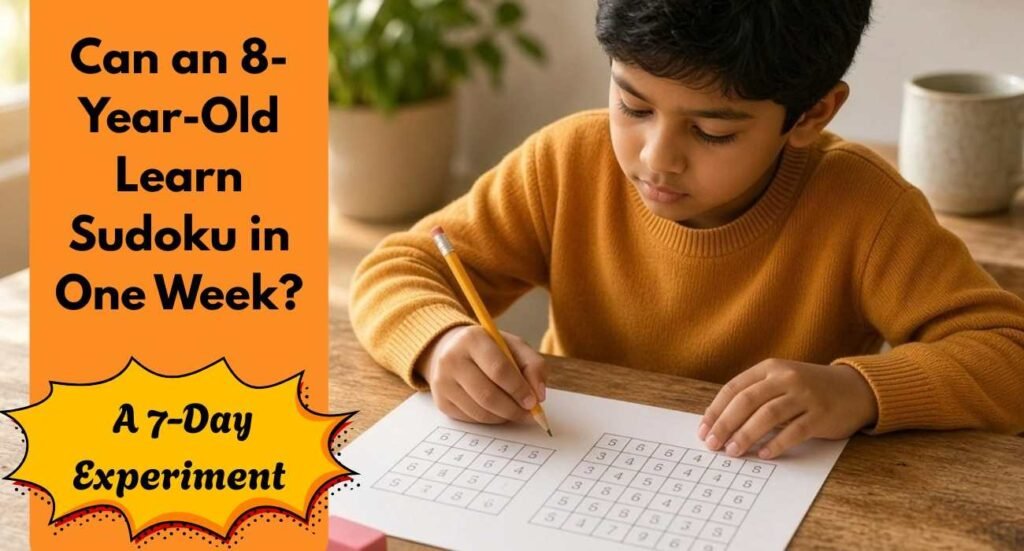

Can an 8-Year-Old Learn Sudoku in One Week? Yes — if you define “learn” the way an 8-year-old actually learns. In seven short sessions most third-graders can grasp the three rules, solve 4×4 grids alone, finish easy 6×6 puzzles with light help, and place their first numbers on a standard 9×9 board. They will not become speed solvers. That is the honest week-one result and it is enough.
What “learn Sudoku” should mean at age 8?
Parents type this question into Google because they saw a 9×9 grid and imagined their child drowning in 81 empty squares. That picture is the wrong target.
At eight years old, a successful first week looks like this:
- The child can explain the rule in their own words: every row, every column, every box gets each number once.
- They can finish a 4×4 number puzzle without you pointing at cells.
- They can scan a 6×6 row and say which number is missing.
- They try an easy 9×9 without panic, even if they only fill 8–12 cells on their own.
- They ask to do another puzzle. That last point matters more than speed.
Sudoku is not arithmetic. The digits are labels, the same way colored fruit or animal pictures are labels in picture Sudoku. If your 8-year-old can read the numbers 1 through 9 and sit still for ten minutes, they already have the prerequisites.
Why one week is a realistic window?
The rules take under ten minutes to understand. What takes days is the habit of looking in three places before writing a number: the row, the column, and the box. That habit is a working-memory drill. Eight-year-olds are in the exact developmental window where working memory and systematic scanning grow quickly, which is why a short daily session compounds.
A week works because it is short enough to stay novel and long enough for the rule to move from “something Mum said” to “something I check myself.” Stretch the same content over a month and many children lose the thread. Cram it into one Saturday and they associate Sudoku with a long, tiring afternoon.
The setup (10 minutes, once)
Buy nothing. You need a pencil with an eraser, printed 4×4 and 6×6 grids (search “printable mini Sudoku for kids”), and one easy 9×9 with plenty of given numbers — usually 38 to 45 clues. Skip apps for the first four days. Paper makes mistakes cheap and visible.
Pick a consistent slot. After snack, before screens, works better than “when we have time.” Cap every session at 15 minutes and stop on a completed puzzle, not on a stuck one.
The only adult rule: you think out loud for the first two days, then you ask questions instead of giving answers. “Which numbers are already in this row?” beats “Put a 3 there.”
The 7-day kitchen-table plan
Day 1 — The rule, not the grid
Time: 8–10 minutes · Grid: a 4×4 that is already three-quarters full
Do not start with a blank board. Hand over a 4×4 with only three empty cells. Say this, almost word for word:
“This is a number puzzle. Every line across, every line down, and every little square must have 1, 2, 3, and 4. No twins. Find the empty box that can only be one number.”
Let them place all three numbers. Celebrate the finish like a small win, because it is one. If they guess, do not correct immediately. Wait until two identical numbers sit in the same row, then ask, “Can a row have two 3s?” That contradiction teaches more than a lecture.
Day-1 success: they finish one nearly complete 4×4 and can repeat the no-twins rule.
Day 2 — First real 4×4
Time: 10–12 minutes · Grid: two easy 4×4 puzzles, 8–10 given numbers each
Teach the only technique they need this week: scanning. Pick a number that already appears twice on the board. “Let’s hunt all the 2s. This row already has a 2, this column already has a 2, so the last 2 in this box has only one home.”
Do the first puzzle together. Hand them the second one. Stay in the room but stop pointing. If they stall for more than a minute, ask which number appears most often. Frequency is a gift at this age — the board itself tells them where to look.
Common snag: they stare at one empty cell. Move their eyes to a row that has only one hole.
Day 3 — Independence on mini grids
Time: 12 minutes · Grid: three 4×4 puzzles, last one with fewer clues
Today you are a timer and a cheerleader, not a co-solver. Most 8-year-olds who did Days 1 and 2 will finish a friendly 4×4 in two to four minutes. That speed is not the goal. The goal is that they check row, column, and box without being told.
If they still need you on every cell, do not jump to 6×6 tomorrow. Repeat Day 3. Grid size is a vanity metric. Rule fluency is the real progress.
Day-3 success: one 4×4 completed with zero adult hints.
Day 4 — The 6×6 bridge
Time: 15 minutes · Grid: one easy 6×6 (numbers 1–6, 2×3 boxes)
This is the day that feels like “real Sudoku” to a child. The board is bigger. Working memory has more to hold. Warn them before you start: “This one is longer, not harder. Same rule. More houses for the numbers to live in.”
Sit beside them for the first six placements, then lean back. Introduce pencil marks only if they ask what to do when two numbers could fit. Tiny corner digits are optional at eight. Many children do better if they skip notes and hunt for cells that can only be one number until the board opens up.
Stop-rule: if shoulders rise or they start guessing, finish the current box together and close the book. Leave them wanting the next square, not fleeing it.
Day 5 — Scanning by number, not by cell
Time: 15 minutes · Grid: one 6×6, then a second if they want it
Upgrade the method. Instead of wandering cell to cell, they pick one digit and walk it around the whole grid. “Where can 5 live in the top band? It is already in this box and this column, so…” This is the same scanning adults use on easy 9×9 puzzles. Teaching it on 6×6 keeps the board small enough that the child can see the whole pattern.
Ask them to narrate. Out-loud reasoning is how you know the logic is theirs. “Because this row already has a 4” is a complete sentence at this age. Treasure it.
Day 6 — Meet the 9×9 without fear
Time: 15 minutes · Grid: one easy 9×9 with 40+ given numbers
Unfold the full grid and say the most useful sentence of the week: “You do not have to finish this today.” That single line prevents the slump that kills most first 9×9 attempts.
Start in the 3×3 box that already holds the most numbers. Fill only the obvious cells. Count them at the end. Eight correct placements on day six is a win. Twelve is a great session. A completed easy 9×9 in week one happens for some children, not most, and it is not required.
If the page looks like a wall, put a blank index card over two-thirds of the grid so only one band is visible. Shrink the world. The rule does not change.
Day 7 — Proof of learning
Time: 15 minutes · Grid: one 4×4 warm-up, one 6×6, a few cells on a 9×9
This is the exam that does not feel like an exam. Watch without coaching. You are collecting evidence, not scores.
Can they state the rule? Can they finish the 4×4 alone? Can they place at least five numbers on the 6×6 by scanning? Do they still want another page tomorrow? If three of those four are yes, an 8-year-old learned Sudoku in one week.
What a realistic week-one scoreboard looks like?
| Skill | Typical day-1 | Typical day-7 |
|---|---|---|
| Explain the rule | Repeats your words | Uses their own wording |
| 4×4 solve | Needs pointing | Independent, 2–5 min |
| 6×6 solve | Not started | Partial or full with light help |
| Easy 9×9 | Looks huge | Places obvious singles; may not finish |
| Guessing | Default move | Drops once contradiction is felt |
| Attitude | Curious or wary | Owns the pencil |
Five mistakes that stall an 8-year-old
- Starting on 9×9. The logic is identical on 4×4. The intimidation is not.
- Sessions longer than 15 minutes. Attention at eight is a sprinter, not a marathoner.
- Correcting every error the second it happens. Let the contradiction appear. Logic is self-checking.
- Turning it into math practice. The moment you say “this will help your sums,” the game dies.
- Praising speed. Praise the check: “You looked at the box before you wrote. That is the skill.”
What this week actually trains?
You are not teaching a party trick. You are rehearsing a thinking pattern teachers already want in grade three: hold a rule in mind, scan for evidence, eliminate what cannot be true, commit only when one option remains. That pattern shows up in reading comprehension, in multi-step word problems, and in “check your work” — except Sudoku makes the feedback instant.
Brain-imaging work on Sudoku consistently lights up frontoparietal networks used for working memory and cognitive control. That is adult data, not a miracle claim for one week with a third-grader. Treat the puzzle as structured practice, not as a supplement that replaces sleep, outdoor play, or actual math instruction.
If week one goes sideways
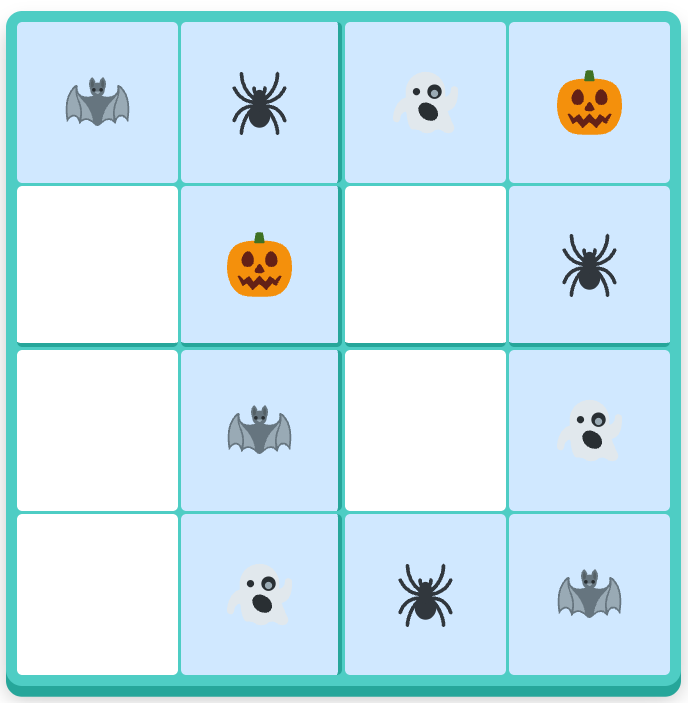
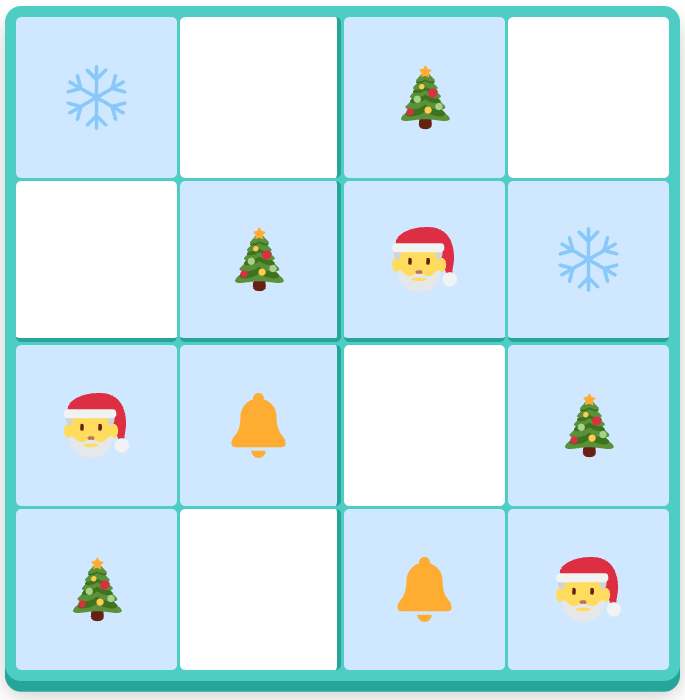
Some eight-year-olds bounce off numbers. Switch the symbols. Picture Sudoku — animals, fruit, vehicles — uses the identical rule on a 4×4. After two picture wins, swap the pictures for digits. The logic transfers.

Some children race and guess. Put the pencil down and use coins or colored tiles they can physically move. A wrong tile is easier to undo than a wrong digit, and the board stays clean.
Some want to quit on Day 4 when the grid grows. That is normal. Return to a 4×4 “warm-up win,” then try only the top two rows of the 6×6. Shrink the assignment, keep the streak.
After day 7: the only next step that matters
Do not buy an expert book. Do one easy puzzle most days for two more weeks. When 6×6 feels automatic, keep the easy 9×9 and ignore medium. Medium puzzles demand pencil-mark pairs and longer holds in working memory. That is month two for most children this age, not week two.
The children who still like Sudoku in a month are the ones whose first week ended with a finished small grid and a parent who stopped talking in time.
FAQs: Can an 8-Year-Old Learn Sudoku in One Week
Q.1: Can every 8-year-old learn Sudoku in seven days?
Ans: No. Children with very short attention, shaky number recognition, or high frustration sensitivity may need two weeks on 4×4 alone. The plan still works. Only the calendar stretches.
Q.2: Is Sudoku too hard for third grade?
Ans: Standard hard 9×9 is too hard. Easy 4×4 and 6×6 are the right size. Many third-grade classrooms already use mini Sudoku as a quiet logic warm-up.
Q.3: Does Sudoku help with math marks?
Ans: It does not teach addition. It trains the patience and elimination habits that help when a word problem has several constraints. Do not sell it as a grade booster. Sell it as a puzzle.
Q.4: Should we use an app?
Ans: From Day 5 onward, a good kids Sudoku app is fine for travel. For the first four days, paper wins. Erasing a guess with a pencil teaches more than tapping undo.
Q.5: How do I know they are ready for 9×9?
Ans: They finish easy 6×6 puzzles without asking where to look, and they can focus for a full 12 minutes. Age is a hint. Those two signs are the test.
The verdict
An 8-year-old can learn Sudoku in one week if you start small, stop early, and measure learning by the rule they can say and the 4×4 they can finish alone. The 9×9 grid is a destination, not the front door.
Print a 4×4 tonight. Leave three cells empty. Hand over the pencil. That is Day 1. The rest of the week is just repeating that feeling of “I figured it out” on a slightly larger page.

Sweta MS is the founder and editor of Sudoku Times. A passionate Sudoku enthusiast and logic puzzle solver for over 12 years, she has solved thousands of puzzles ranging from easy to expert level. Sweta specializes in breaking down advanced solving techniques (X-Wing, Swordfish, XY-Wing and more) into clear, practical guides that help beginners and intermediate players improve faster. Through Sudoku Times, she shares daily puzzles, strategy tutorials and insights into how Sudoku trains the brain. Her goal is to make high-quality Sudoku content accessible, enjoyable and effective for players of all skill levels.