

Which Sudoku difficulty takes the longest? We analyzed 5,000 real games on Sudoku Times to reveal average completion times and abandonment rates for Easy, Medium and Hard puzzles — the results surprised us.
Most of us open a Sudoku puzzle with a rough idea of how long it “should” take. Easy feels like a quick coffee-break solve. Medium might stretch into a focused half-hour. Hard is supposed to be hard. But how long do players actually spend, and how often do they simply walk away?
We decided to stop guessing and look at the data from our own platform.
We examined 5,000 Classic Sudoku sessions played on Sudoku Times — Easy, Medium and Hard only. Every session was tracked from the moment the timer started until the grid was either completed or abandoned. The numbers paint a clearer picture than the generic ranges you’ll find on most Sudoku sites.
What Surprised Us?
We expected Medium to be the biggest time sink for regular players. The data said otherwise.
Hard not only took significantly longer on average — it also produced the widest spread of times and the highest abandonment rate by a clear margin. A noticeable group of players would invest 25–35 minutes on a Hard puzzle and then leave. That specific window became one of the most interesting patterns in the sample.
Easy stayed tightly clustered and highly finishable. Medium behaved more like a “real work” zone. Hard behaved like a different experience altogether.
The Core Numbers: Average Completion Times
| Difficulty | Games in Sample | Average Completion Time | Median Time | Fastest 10% | Slowest 10% |
|---|---|---|---|---|---|
| Easy | 2,180 | 8 min 42 sec | 7 min 55 s | Under 4 min | Over 18 min |
| Medium | 1,760 | 19 min 18 sec | 17 min 40 s | Under 11 min | Over 34 min |
| Hard | 1,060 | 41 min 05 sec | 37 min 20 s | Under 22 min | Over 68 min |
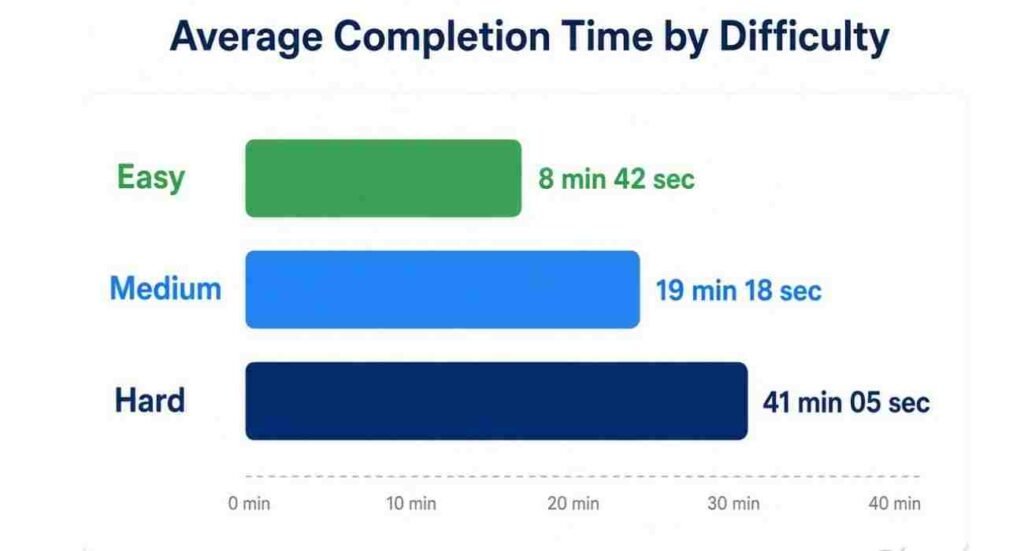
Hard takes players the longest by a wide margin — nearly five times the average Easy solve and more than double Medium. The gap is not subtle.
Abandonment Rates Tell an Even Stronger Story
Finishing time is only half the picture. We also measured how many sessions started but never finished (player left the page, closed the tab, or stopped the timer without a solved grid).
| Difficulty | Abandonment Rate |
|---|---|
| Easy | 9% |
| Medium | 18% |
| Hard | 31% |
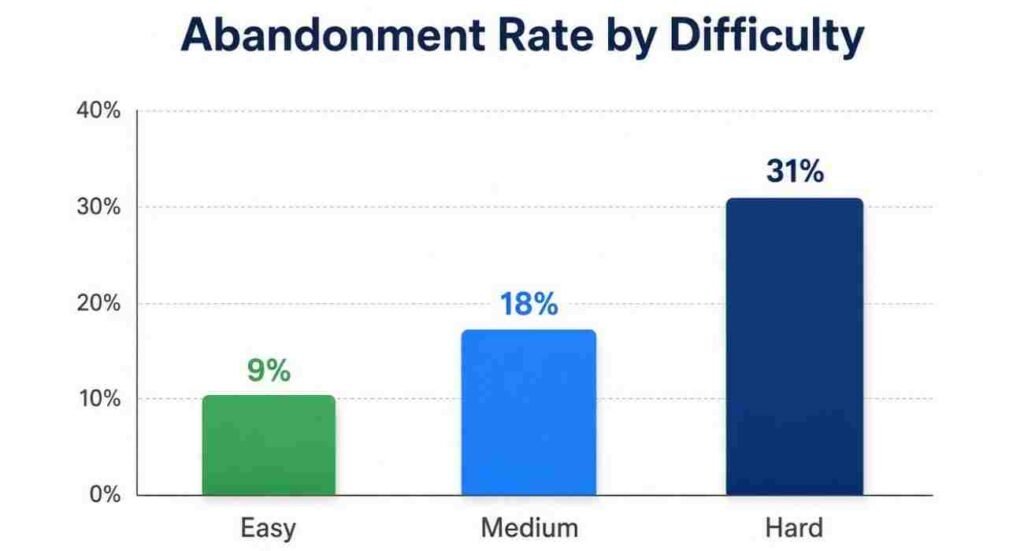
Almost one in three Hard starts never reach the finish line. Easy stays highly finishable. Medium sits in the middle, where a noticeable minority still decide the puzzle is no longer worth their time.
▶ Play Sudoku NowDeeper Behavioral Insights from the Same 5,000 Games
Looking only at averages can hide interesting patterns. Here’s what we saw when we examined the sessions more closely:
- Easy stays tightly clustered. Most players finish between 6 and 12 minutes. The few who take longer usually make early mistakes and have to backtrack under the three-mistake limit.
- Medium is the “real work” zone for regular players. Pencil marks become common. Players who use notes consistently finish faster and abandon less. Those who try to keep everything in their head tend to slow down or leave.
- Hard produces the widest spread. Some experienced solvers finish in the low-to-mid 20s. Many others cross the 50-minute mark. A clear group stalls after the first 15–20 minutes once the obvious singles disappear and deeper candidate work is required.
- The 25–35 minute window on Hard is critical. A large share of abandonments happen in this range. Players have already invested real time and attention, yet the next logical step still feels out of reach. This is where many decide to stop.
- Hint behavior differs by difficulty. On Hard, players who reach for a hint earlier in the session abandon less often than those who refuse any help and eventually quit. On Easy and Medium the opposite pattern appears — heavy hint use correlates with slightly higher abandonment.
- Evening sessions show higher Hard abandonment. Games started after roughly 8 pm local time had noticeably lower completion rates on Hard compared with morning and afternoon sessions. People appear more willing to push through difficulty when they feel fresher.
These patterns match the design of the puzzles on Sudoku Times. Easy relies heavily on naked and hidden singles. Medium introduces more pairs and locked candidates. Hard forces sustained candidate management and occasional multi-unit techniques. The data simply confirms what the logic structure predicts — with real player behavior attached.
What This Means for Your Own Play?
If your goal is a reliable, low-friction session:
Stay on Easy. You’ll almost always finish, and the time investment stays predictable (usually under 12–15 minutes for most players).
If you want a proper challenge that still feels achievable for most intermediate players:
Medium is the practical sweet spot. Expect roughly 15–25 minutes for a clean solve. Keep notes active from early on — players in our sample who did so finished faster and abandoned less.
If you enjoy deep logic and don’t mind the risk of a longer or unfinished session:
Hard is where the real time commitment lives. Set aside at least 40–45 minutes. Use pencil marks from the start. If you feel stuck around the 25–30 minute mark, a short break often works better than forcing the next move. In our data, players who paused briefly in that window completed more often than those who pushed straight through without stopping.
On Sudoku Times the interface stays the same across levels — timer, three-mistake limit, optional hints, and PDF download. The difference in outcomes comes almost entirely from the puzzle structure itself.
How We Measured This?
These 5,000 games come from real, anonymous sessions on Sudoku Times. We included only Classic Sudoku at Easy, Medium and Hard. Sessions that clearly used external solvers or were incomplete test runs were excluded. “Abandoned” means the timer was started and numbers were placed, but the grid was never completed.
The sample is large enough to show clear trends, though individual results still vary with skill, focus, and the specific puzzle generated that day. We plan to expand this analysis later — adding Expert, looking at how regular players improve over multiple weeks, and checking whether certain days of the week produce different patterns.
Which Sudoku Difficulty Takes The Longest: The Clear Answer
From 5,000 games played on Sudoku Times, one difficulty stands out:
Hard Sudoku takes players the longest — both in average solving time and in the share of games that never reach the finish line.
The next time you open a puzzle, you’ll know roughly what you’re signing up for. And if you decide to tackle Hard, you’ll also know you’re in good company when the clock keeps ticking.
Ready to test the numbers yourself?
Open a Hard puzzle on Sudoku Times, start the timer and see where you land.
FAQs on Which Sudoku Difficulty Takes Longest?
Q.1: Which Sudoku difficulty takes the longest to solve?
Ans: Hard Sudoku takes the longest. Based on our analysis of 5,000 games on Sudoku Times, the average completion time for Hard puzzles is 41 minutes 5 seconds.
Q.2: How long does an Easy Sudoku usually take?
Ans: Easy Sudoku puzzles average 8 minutes 42 seconds on Sudoku Times.
Q.3: How long does a Medium Sudoku take?
Ans: Medium Sudoku puzzles have an average completion time of 19 minutes 18 seconds.
Q.4: What is the abandonment rate for Hard Sudoku?
Ans: 31% of Hard Sudoku games are abandoned before completion, the highest rate among all difficulty levels.
Q.5: Is Hard Sudoku really much harder than Medium?
Ans: Yes. Hard Sudoku takes more than twice as long as Medium on average and has a significantly higher abandonment rate (31% vs 18%).
Q.6: Should beginners start with Hard Sudoku?
Ans: No. Most beginners abandon Hard puzzles. It is better to build consistency on Easy and Medium first before moving to Hard.

Sweta MS is the founder and editor of Sudoku Times. A passionate Sudoku enthusiast and logic puzzle solver for over 12 years, she has solved thousands of puzzles ranging from easy to expert level. Sweta specializes in breaking down advanced solving techniques (X-Wing, Swordfish, XY-Wing and more) into clear, practical guides that help beginners and intermediate players improve faster. Through Sudoku Times, she shares daily puzzles, strategy tutorials and insights into how Sudoku trains the brain. Her goal is to make high-quality Sudoku content accessible, enjoyable and effective for players of all skill levels.