

Sudoku has fascinated puzzle enthusiasts for decades with its perfect blend of logic, pattern recognition and satisfaction upon completion. Whether you are picking up your first 9×9 grid or have been dabbling for months, the burning question remains: How long does it take to become good at Sudoku?
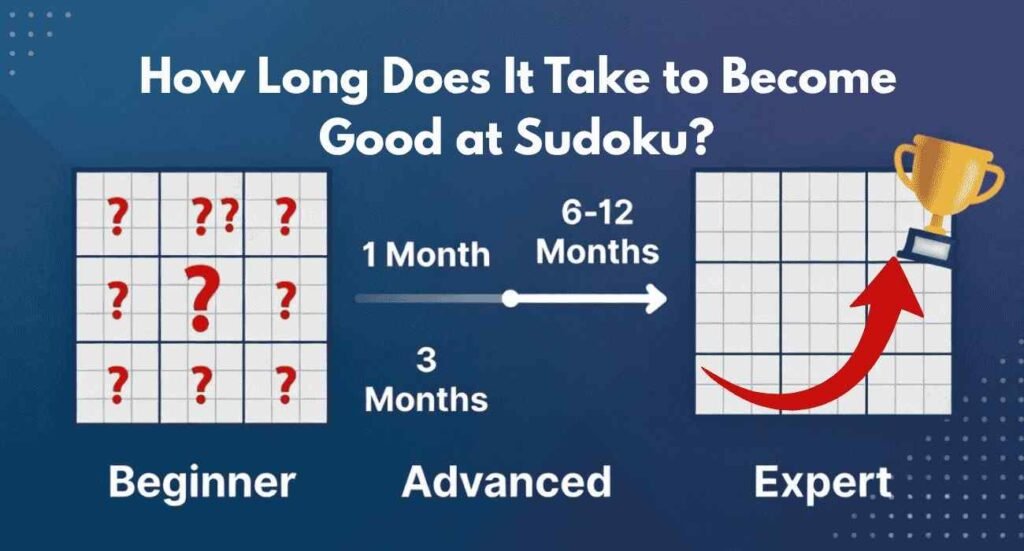
The short answer is that it varies widely based on your starting point, practice habits, learning approach and personal definition of “good.” For most dedicated players, noticeable improvements appear within the first few weeks. Reaching a solid intermediate level—where you confidently tackle medium and hard puzzles—typically takes 1 to 3 months of regular play. Advanced proficiency, including expert-level solving with advanced techniques and faster times, often emerges between 6 and 12 months. True mastery, where you breeze through challenging puzzles and even experiment with extremes, can take a year or more of consistent effort.
This comprehensive guide dives deep into player progression data drawn from community experiences, app statistics, and solver insights. We will break down realistic timelines, key stages, influencing factors, actionable plans, common pitfalls, cognitive benefits and expert strategies to accelerate your journey. By the end, you will have a clear roadmap tailored to your goals, whether you seek casual enjoyment or competitive edge.
Understanding What “Good at Sudoku” Really Means
” Good” is subjective in the Sudoku world. For a casual player, it might mean finishing a daily newspaper puzzle without frustration or errors in under 20 minutes. For enthusiasts, it could involve solving expert grids efficiently or recognizing complex patterns instinctively. Competitive solvers aim for record-breaking speeds on standardized puzzles.
Consider these benchmarks based on widespread player reports:
- Beginner Level: Solving easy puzzles reliably, even if it takes 15-30 minutes or more.
- Novice/Improving: Comfort with medium puzzles in 10-25 minutes, using basic techniques like scanning and singles.
- Intermediate: Handling hard puzzles in 15-30 minutes, incorporating pairs, triples, and simple eliminations.
- Advanced: Expert puzzles in under 15-20 minutes, fluent with X-Wings, Swordfish, and basic chains.
- Expert/Master: Sub-10-minute hard puzzles, tackling extremes logically, and optimizing for speed.
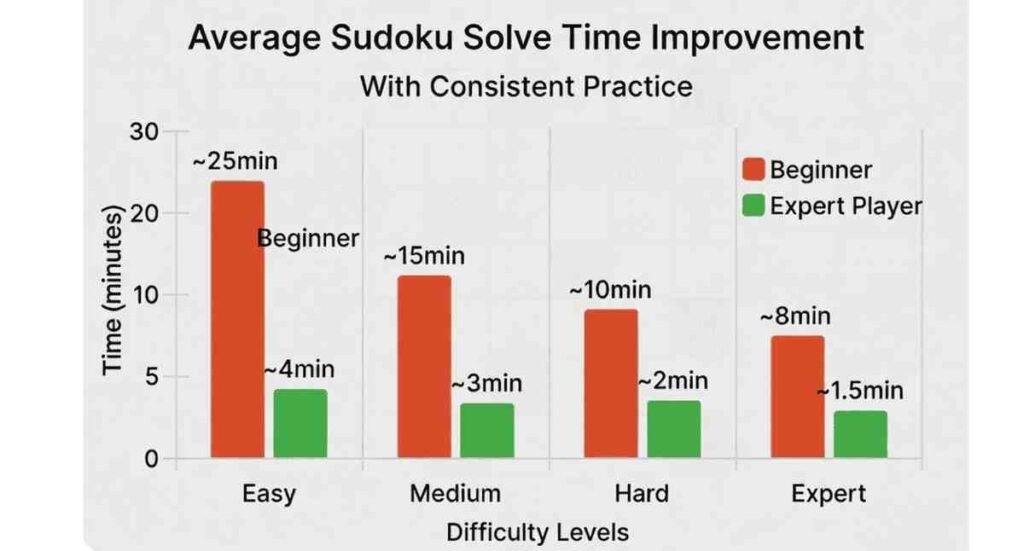
Data from popular Sudoku apps and forums shows that average solve times improve dramatically with practice. Beginners often spend 20+ minutes on easy grids, while seasoned players finish the same in 3-5 minutes. Hard puzzles that once took an hour shrink to 10-15 minutes for dedicated practitioners.
The beauty of Sudoku lies in its accessibility. No prior math skills are required beyond basic number placement—success stems from logical deduction and persistence.
The Science and Psychology Behind Sudoku Skill Development
Sudoku engages multiple brain regions, including those responsible for working memory, spatial reasoning and executive function. Regular play strengthens neural pathways, making pattern recognition faster and more intuitive over time. This neuroplasticity explains why consistent practice yields compounding returns.
Psychologically, Sudoku offers immediate feedback and a sense of accomplishment, which reinforces the habit loop. Early frustration gives way to flow states as skills grow. Many players report entering a meditative zone during solves, where time flies and stress melts away.
Player progression follows a classic learning curve: steep initial gains from mastering fundamentals, followed by plateaus requiring deliberate technique study, and eventual breakthroughs into advanced territory. Those who push through plateaus by learning new strategies see the fastest overall improvement.
Detailed Sudoku Player Progression Stages with Timelines
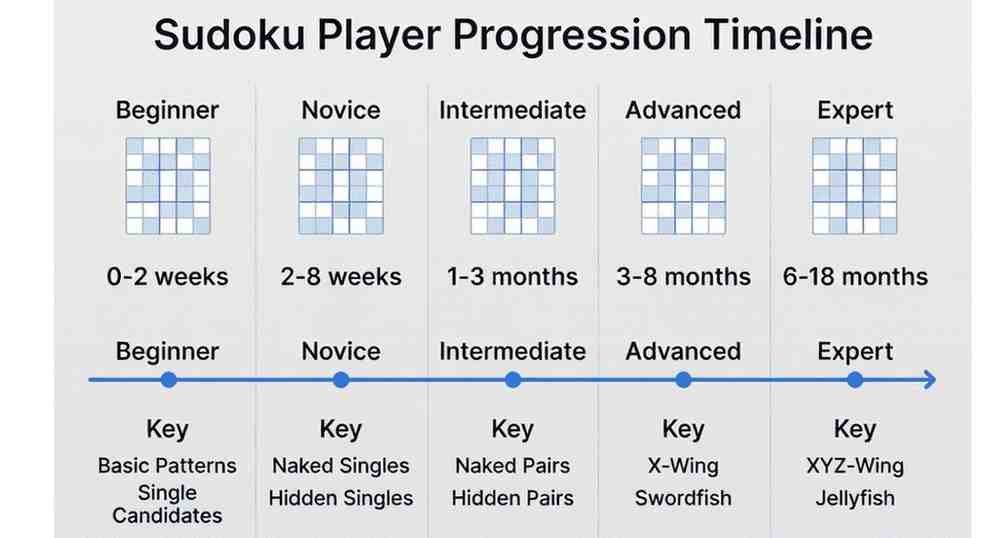
Stage 1: Beginner (Days 1-14)
You start with basic rules: fill the grid so each row, column and 3×3 box contains digits 1-9 without repetition. Early puzzles feel overwhelming as you hunt for obvious placements.
Typical timeline: 1-2 weeks of daily 15-30 minute sessions. Focus on easy puzzles. Solve times: 15-45+ minutes initially, dropping as you internalize scanning (checking rows/columns/boxes for missing numbers).
Key skills: Naked singles (cells with only one possible number), basic pencil marking (noting candidates lightly). Many beginners experience “aha” moments when they spot their first hidden single. By week two, easy puzzles feel manageable.
Stage 2: Novice/Improving (Weeks 2-8)
Progress accelerates here. You begin recognizing patterns beyond singles. Medium puzzles become approachable.
Timeline: 4-6 additional weeks. Practice mix of easy and medium. Solve times improve to 8-15 minutes for easy and 15-30 for medium.
Techniques introduced: Hidden singles/pairs, locked candidates (pointing pairs and claiming), basic eliminations. Players often double their speed by focusing on one technique per session. Community reports show many cutting total solve time by 40-50% in this phase through deliberate practice.
Stage 3: Intermediate (Months 1-3)
This is where most players feel “good.” Hard puzzles no longer intimidate. You develop systematic approaches rather than random guessing.
Timeline: Cumulative 1-3 months. Daily practice with increasing difficulty. Solve times: Medium under 15 minutes, hard 20-40 minutes.
Advanced fundamentals: X-Wing, Swordfish, Y-Wing, unique rectangles. You learn to scan the entire grid efficiently and use candidate lists strategically. Plateaus are common—overcome them by reviewing solved puzzles to identify missed opportunities.
Stage 4: Advanced (Months 3-8)
Expert grids yield to your growing arsenal. Speed and accuracy rise noticeably.
Timeline: 3-8 months total. Incorporate timed sessions and technique drills. Solve times: Hard under 15-20 minutes, expert 20-45 minutes.
Techniques: Forcing chains, Almost Locked Sets (ALS), grouped inferences. You start anticipating interactions across distant parts of the grid. Many players join online communities for puzzle recommendations and feedback.
Stage 5: Expert and Beyond (6-18+ Months)
You solve most published “hard” puzzles efficiently and experiment with extremes. Speed optimization becomes a focus—reducing unnecessary notes and visualizing patterns mentally.
Timeline: 6 months to years for mastery. Consistent play plus study of advanced resources. Top solvers achieve sub-5-minute times on challenging grids through pattern fluency and mental shortcuts.
These timelines assume 15-45 minutes of focused daily practice. Sporadic play stretches them; intensive focused training shortens them.
Real-World Player Data and Statistics
Aggregated insights from thousands of solvers reveal:
- Easy puzzles: Beginners 15-30 minutes → Experts under 5 minutes.
- Medium: 15-40 minutes average initially → 5-15 minutes with experience.
- Hard/Expert: Often 30-90+ minutes for intermediates → 10-30 minutes for advanced.
- Improvement rate: Many report 30-50% time reduction every 4-6 weeks with consistent effort.
App leaderboards show dedicated users climbing ranks rapidly in the first months. Forum threads highlight stories of players going from hour-long struggles to confident 10-minute solves after learning core techniques.
Factors Influencing Your Sudoku Learning Curve
Several variables affect progress speed:
Practice Consistency and Volume: Short daily sessions outperform marathon weekends. Aim for quality over quantity—focus on learning from each puzzle.
Learning Method: Passive solving helps, but active study of techniques (watching explanations, reviewing mistakes) accelerates growth exponentially.
Age and Background: Logical thinkers or those with puzzle experience start faster, but all ages improve. Seniors often report cognitive sharpness gains.
Tools Used: Pencil-and-paper builds deeper understanding; apps provide instant feedback and statistics.
Motivation and Mindset: Viewing challenges as opportunities rather than failures prevents burnout. Celebrate milestones like first expert solve.
Puzzle Quality: Start with well-designed puzzles that match your level. Poorly constructed ones can frustrate unnecessarily.
External life factors like stress or fatigue also play roles—solve when mentally fresh for best results.
90-Day Actionable Plan to Transform Your Sudoku Skills
Month 1: Foundations
- Days 1-10: Easy puzzles daily. Master scanning and singles. Track times.
- Days 11-20: Introduce medium. Learn pairs and basic eliminations.
- Days 21-30: Mixed levels. Review one new technique every few days. Goal: Easy under 10 minutes, medium under 25.
Month 2: Building Proficiency
- Focus on hard puzzles. Drill X-Wing and Swordfish.
- Use timed challenges. Analyze slow solves for missed patterns.
- Goal: Consistent medium solves under 15 minutes.
Month 3: Acceleration
- Tackle expert puzzles. Introduce chains and advanced patterns.
- Experiment with minimal note-taking for speed.
- Join challenges or compare with friends.
Ongoing Habits: Maintain a puzzle journal. Weekly review progress. Mix difficulties to stay engaged. Incorporate rest days to avoid burnout.
Supplement with free online resources, technique articles, and solver apps. Many players see dramatic leaps after implementing this structured approach.
Common Myths and Pitfalls to Avoid
Myth 1: You Need Innate Talent
Reality: Dedication and smart practice matter far more. Most “naturals” simply practiced effectively early on.
Myth 2: More Puzzles = Faster Progress
Reality: Quality matters. Solving without learning techniques leads to slow plateaus.
Myth 3: Guessing Is Necessary for Hard Puzzles
Reality: Proper logic always suffices. Guessing slows long-term growth.
Pitfall: Ignoring Pencil Marks
Early on, detailed candidates prevent errors and reveal patterns.
Pitfall: Rushing Advanced Techniques
Master basics first. Premature attempts at chains cause confusion.
Pitfall: Comparing to Others
Focus on personal bests. Everyone’s journey differs.
The Deeper Benefits of Mastering Sudoku
Beyond entertainment, Sudoku delivers profound advantages:
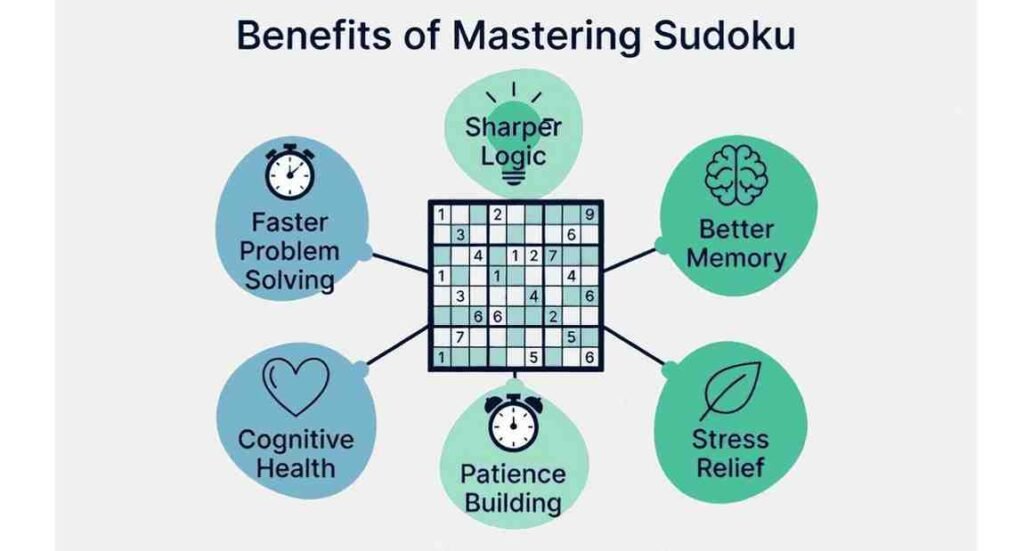
- Cognitive Health: Enhances memory, attention, and problem-solving. Regular play correlates with slower cognitive decline.
- Stress Relief: The focused yet relaxing nature promotes mindfulness.
- Patience and Persistence: Teaches breaking complex problems into steps.
- Confidence Boost: Overcoming tough grids builds resilience applicable elsewhere.
- Social Connection: Share puzzles with family or join communities.
Many players discover improved performance in work or studies due to sharpened logic.
Advanced Strategies for Continued Growth
Once intermediate, explore:
- Coloring and Chains: Visualize implications across the grid.
- Uniqueness Patterns: Use grid constraints creatively.
- Speed Techniques: Scan efficiently, minimize notes, practice pattern recognition.
- Variant Puzzles: Killer Sudoku, Samurai Sudoku, or irregular grids expand skills.
- Mental Solving: Visualize without paper for advanced practice.
Study famous hard puzzles to understand extreme logic. Analyze solutions from top solvers to internalize their thought processes.
Tracking Progress and Staying Motivated Long-Term
Use apps with statistics: average times per difficulty, streak counters, accuracy rates. Set monthly goals like “solve 50 hard puzzles under 20 minutes.”
Reward milestones—treat yourself after completing a tough challenge. Vary routines: timed races one day, relaxed exploration the next. Teach others to reinforce your knowledge.
Remember, plateaus are normal. Switch resources or take a short break when stuck. Return refreshed for breakthroughs.
Conclusion: Your Sudoku Journey Starts Now
Becoming good at Sudoku is an achievable, rewarding process. With 15-30 minutes daily, structured learning, and patience, you can transform from novice to skilled solver in months. The exact timeline is yours to shape through consistent effort and curiosity.
Start today with an easy puzzle. Note your time and techniques used. In a week, review improvements. In a month, marvel at your growth. Sudoku rewards every player who persists—the grid awaits your mastery.
This journey offers more than faster solves. It builds a sharper mind, greater patience, and endless intellectual pleasure. Embrace the process, celebrate small victories, and enjoy the timeless satisfaction of a completed grid.
FAQs on How Long Does It Take to Become Good at Sudoku
Q.1- How long does it take for a beginner to get good at Sudoku?
Ans- Most beginners see noticeable improvements in 2 to 4 weeks with daily practice of 15-30 minutes. They can reach a comfortable intermediate level—solving medium puzzles reliably—in 1 to 3 months, depending on consistency and technique learning.
Q.2- What is a good solve time for Sudoku puzzles?
Ans- A good solve time varies by difficulty: easy puzzles under 10 minutes, medium under 15 minutes, hard under 20-25 minutes, and expert under 30-45 minutes for advanced players. Beginners may take longer initially, but times improve rapidly with practice.
Q.3- How many Sudoku puzzles should I solve daily to improve fast?
Ans- Solving 3 to 5 puzzles daily, focusing on quality and learning one new technique per session, yields excellent results. Consistency matters more than volume—short focused sessions of 20-30 minutes are highly effective for steady skill growth.
Q.4- Can you become good at Sudoku in one month?
Ans- Yes, many players reach intermediate level in one month with dedicated daily practice. You can master basics, reduce solve times significantly, and handle medium to early hard puzzles confidently by focusing on core techniques and reviewing mistakes.
Q.5- What techniques should beginners learn first in Sudoku?
Ans- Beginners should start with scanning for naked and hidden singles, followed by basic pencil marking, pairs, and triples. These foundational methods allow quick progress before moving to advanced patterns like X-Wing or Swordfish.
Q.6- Does age affect how long it takes to get good at Sudoku?
Ans- Age does not prevent improvement—players of all ages progress well with practice. Younger solvers may advance slightly faster due to quicker pattern recognition, while older adults often gain significant cognitive benefits and steady skill growth over time.
Q.7- How can I reduce my Sudoku solve time quickly?
Ans- Practice scanning the entire grid first, learn key elimination techniques, use efficient pencil marks, review solved puzzles for missed opportunities, and solve timed sessions daily. Focusing on one difficulty level until comfortable also speeds up improvement.
Q.8- Is it possible to solve hard Sudoku without guessing?
Ans- Yes, proper logical deduction and advanced techniques like forcing chains, ALS and uniqueness patterns allow solving even the hardest Sudoku puzzles without guessing. Building a strong foundation in basics makes this achievable.
Q.9- What is the best daily practice routine for Sudoku improvement?
Ans- A good routine includes 15-30 minutes daily: warm up with an easy puzzle, tackle one or two harder ones, spend time learning or reviewing a specific technique, and end by analyzing mistakes. Mix difficulties and track progress weekly.
Q.10- How long does it take to solve expert level Sudoku?
Ans- Intermediate players may take 30-60 minutes on expert Sudoku, while advanced solvers often finish in 15-30 minutes or less. Mastery comes with regular practice of advanced strategies and pattern recognition.
Q.11- Are Sudoku apps effective for getting good faster?
Ans- Yes, Sudoku apps with timers, statistics, hints, and technique explanations help players improve faster by providing instant feedback, progress tracking, and structured learning tools alongside traditional pen-and-paper solving.
Q.12- What are common mistakes that slow down Sudoku progress?
Ans- Common mistakes include over-relying on guessing, skipping pencil marks, ignoring grid-wide scanning, rushing advanced techniques without basics, and not reviewing solved puzzles. Avoiding these through mindful practice accelerates learning.

Sweta MS is the founder and editor of Sudoku Times. A passionate Sudoku enthusiast and logic puzzle solver for over 12 years, she has solved thousands of puzzles ranging from easy to expert level. Sweta specializes in breaking down advanced solving techniques (X-Wing, Swordfish, XY-Wing and more) into clear, practical guides that help beginners and intermediate players improve faster. Through Sudoku Times, she shares daily puzzles, strategy tutorials and insights into how Sudoku trains the brain. Her goal is to make high-quality Sudoku content accessible, enjoyable and effective for players of all skill levels.