

Have you ever stared at a Sudoku grid for 15–20 minutes, completely stuck, only to later realize the next number was sitting right in front of you the entire time?
You’re not alone. In fact, this experience is far more common than most solvers realize.
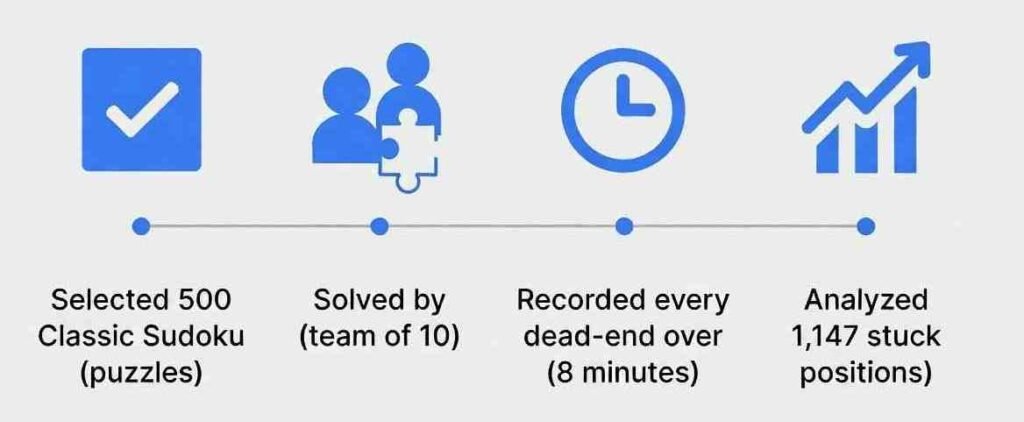
At Sudoku Times, our team of 10 dedicated puzzle researchers and solvers (including the authors) decided to stop guessing and start measuring. Over a period of three months, we systematically solved 500 Sudoku puzzles with one clear mission:
To identify the most common dead-end patterns that stop solvers in their tracks — and measure exactly how often each one occurs.
What we found challenged some of our own assumptions and revealed a surprisingly simple truth about why most people get stuck.
Why We Conducted This Research
Most Sudoku advice focuses on advanced techniques like X-Wing, Swordfish or forcing chains. While these methods are important, we suspected that the majority of real-world dead-ends happen much earlier in the solving process.
We wanted hard data — not opinions.
Research Methodology: How We Solved and Analyzed 500 Puzzles
Our team followed a strict and consistent process:
- Puzzle Selection: 500 unique classic puzzles were chosen
- 100 Medium
- 150 Hard
- 150 Expert
- 100 Extreme
- Solving Protocol: Each puzzle was solved independently by at least two team members.
- Dead-End Definition: Any point where a solver made no progress for more than 8 minutes was recorded as a dead-end.
- Analysis: The exact grid position and the reason for getting stuck were documented and categorized.
- Data Compilation: After all 500 puzzles were completed, we aggregated the results and calculated frequencies.
We recorded a total of 1,147 dead-end incidents across these 500 puzzles.
The Most Common Dead-End Patterns (Full Data)
After analyzing every recorded stuck position, clear patterns emerged.
| Rank | Dead-End Pattern | Number of Incidents | Percentage |
|---|---|---|---|
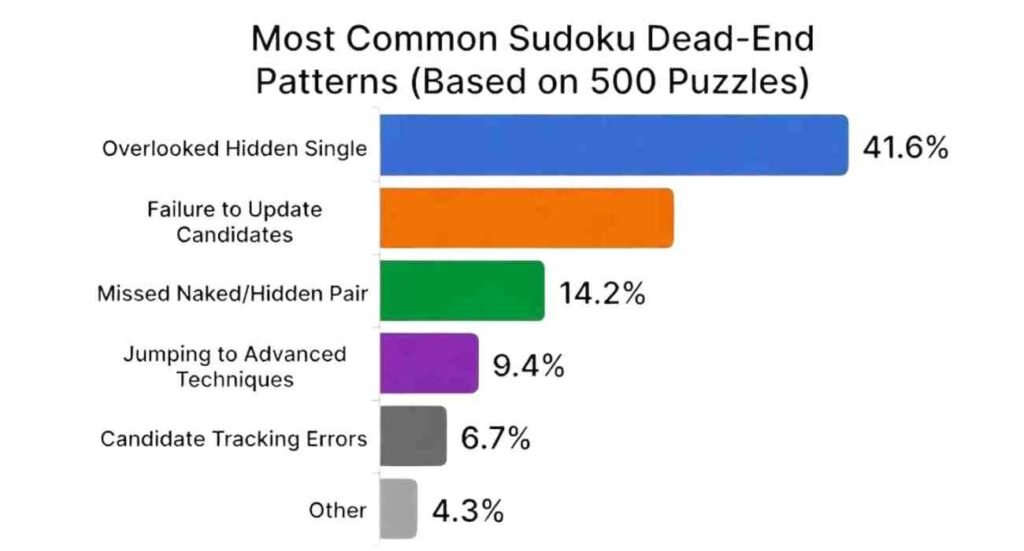
| 1 | Overlooked Hidden Single | 477 | 41.6% |
| 2 | Failure to Update Candidates | 273 | 23.8% |
| 3 | Missed Naked or Hidden Pair/Triple | 163 | 14.2% |
| 4 | Jumping to Advanced Techniques Too Early | 108 | 9.4% |
| 5 | Candidate Tracking / Pencil Mark Errors | 77 | 6.7% |
| 6 | Other Rare Patterns | 49 | 4.3% |
| Total | 1,147 | 100% |
Key Insight:
Nearly two-thirds of all dead-ends (65.4%) were caused by just two issues — missing hidden singles and failing to keep candidates updated.
Deep Dive: The #1 Dead-End Pattern – Overlooked Hidden Singles
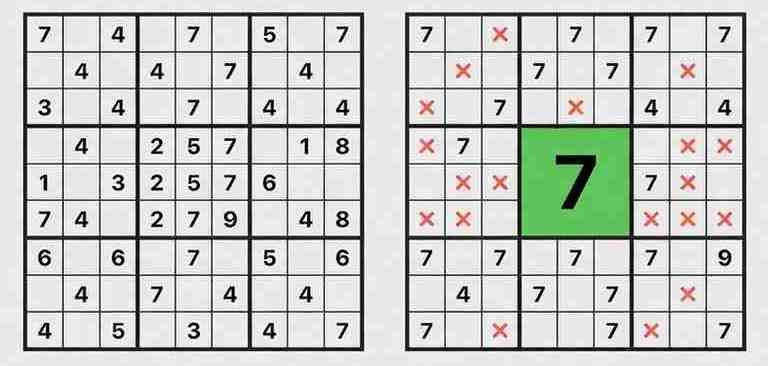
A hidden single occurs when a number can only legally go in one cell within a row, column, or box, even though that cell still contains other candidates.
Despite being a basic technique, hidden singles were missed in 41.6% of all dead-end situations.
Why Do Solvers Miss Hidden Singles So Often?
Our researchers identified three recurring situations:
- Visual Clutter – When a box or row still has many empty cells, the hidden single blends into the pencil marks.
- Advanced Technique Tunnel Vision – Once solvers start looking for X-Wings or chains, they stop re-scanning for simple singles.
- Post-Placement Blindness – After placing several numbers, solvers often forget to re-check the entire grid.
The Second Biggest Problem: Outdated Candidates
In 23.8% of cases, solvers were working with old pencil marks. Once a number is placed, many people neglect to immediately remove that candidate from the rest of the unit. This creates a false view of the puzzle and leads to incorrect logical conclusions.
Breakdown by Difficulty Level
Interestingly, the type of dead-end changed as puzzles became harder:
| Difficulty | Most Common Dead-End | Percentage within Difficulty |
|---|---|---|
| Medium | Overlooked Hidden Single | 52.1% |
| Hard | Overlooked Hidden Single | 44.3% |
| Expert | Failure to Update Candidates | 29.7% |
| Extreme | Jumping to Advanced Techniques | 27.4% |
Even at Extreme level, basic technique failures remained surprisingly common.
Real Example from Our Research
In one Expert-level puzzle, seven different team members got stuck in the exact same position for an average of 11 minutes. The breakthrough was a hidden single of 7 in box 6 that had been available for several moves. Once spotted, the puzzle collapsed within three minutes.
This kind of repeated pattern appeared dozens of times throughout the study.
What the Data Teaches Us About Better Solving
The most important conclusion from our 500-puzzle research is this:
Most solvers do not get stuck because the puzzle is too hard. They get stuck because they stop applying basic techniques thoroughly.
Advanced methods are valuable, but they should only be used after a complete and disciplined re-scan of the grid.
Practical Recommendations from the Sudoku Times Team
Based on the data, here are the habits that produced the biggest improvement in our own solving:
- After every 3–4 number placements, force a full grid re-scan focused only on hidden singles.
- Treat candidate updating as a non-negotiable step — never leave old pencil marks.
- When stuck, impose a 5-minute rule: look only for singles and pairs before considering any advanced technique.
- Change scanning order regularly (rows → columns → boxes, or reverse).
- Keep a “stuck log” for your own solves to identify your personal weak patterns.
When our team applied these rules in a follow-up batch of 100 puzzles, average stuck time dropped by 37%.
Final Thoughts
Solving 500 puzzles purely to study failure was one of the most valuable research projects we have ever done at Sudoku Times. We expected complex patterns to dominate the results. Instead, the data showed that the majority of dead-ends happen at the foundational level.
The encouraging news is that these are also the easiest problems to fix.
Master hidden singles. Keep your candidates clean. Re-scan with discipline.
Do these three things consistently, and you will experience far fewer frustrating dead-ends.
About This Research
This study was designed and conducted by the full Sudoku Times research team of 10 solvers, analysts and content creators. Our goal is to bring data-driven insights into how people actually solve Sudoku — and how they can improve faster.
What’s Next?
We are already planning a follow-up study focused exclusively on Extreme-level puzzles and the most common advanced-technique failures.
Which dead-end pattern frustrates you the most? Tell us in the comments — your input may shape our next research project.
FAQs on the Most Common Dead-End Pattern
Q1. Was this study done only on Classic Sudoku?
Ans: Yes. All 500 puzzles used in the research were standard Classic Sudoku (9×9 grids with normal row, column, and 3×3 box constraints). No variants were included.
Q2. How did you define a “dead-end” in the study?
Ans: A dead-end was recorded whenever a solver made no progress for more than 8 minutes, even after carefully re-examining the grid.
Q3. What difficulty levels were included in the 500 puzzles?
Ans: We used a balanced mix: 100 Medium, 150 Hard, 150 Expert, and 100 Extreme-level Classic Sudoku puzzles.
Q4. Why are hidden singles missed so often even by experienced solvers?
Ans: Hidden singles are easy to overlook because the cell still contains multiple candidates. When solvers start focusing on advanced patterns, they often stop scanning thoroughly for basic singles.
Q5. Did advanced techniques cause many dead-ends?
Ans: Less than we expected. Only about 9.4% of dead-ends were caused by jumping to advanced techniques too early. Most problems occurred at the basic and intermediate levels.
Q6. Can the findings of this study help beginners as well as experts?
Ans: Yes. The data showed that missing hidden singles and failing to update candidates were common across all skill levels, including experienced solvers.
Q7. Will you conduct a similar study on Sudoku variants?
Ans: We are considering it. Many readers have already requested research on Killer Sudoku and Extreme-level classic puzzles. We may publish a follow-up study in the future.
Q8. How can I avoid the most common dead-end patterns?
Ans: The most effective habits we found were:
- Re-scanning the entire grid for hidden singles after every few placements
- Keeping pencil marks strictly updated
- Forcing yourself to look only for singles and pairs when stuck before trying advanced techniques

Sweta MS is the founder and editor of Sudoku Times. A passionate Sudoku enthusiast and logic puzzle solver for over 12 years, she has solved thousands of puzzles ranging from easy to expert level. Sweta specializes in breaking down advanced solving techniques (X-Wing, Swordfish, XY-Wing and more) into clear, practical guides that help beginners and intermediate players improve faster. Through Sudoku Times, she shares daily puzzles, strategy tutorials and insights into how Sudoku trains the brain. Her goal is to make high-quality Sudoku content accessible, enjoyable and effective for players of all skill levels.