

Sudoku has evolved from a simple number-placement game into a global phenomenon that sharpens the mind and tests the limits of logical reasoning. What began as a casual diversion in newspapers has spawned variants, championships, and a dedicated community of solvers who chase the thrill of cracking the uncrackable.
But amid the millions of grids out there, a select few stand as towering monuments to difficulty—puzzles so fiendishly designed they demand not just patience, but a symphony of advanced techniques, deep pattern recognition, and sometimes a dash of computational verification.
These aren’t your daily coffee-break fillers; they’re intellectual marathons that have stumped experts, inspired algorithms, and even been analyzed in scientific papers for their chaotic solving dynamics.
In this post, we’ll dive into the Top 9 Hardest Sudoku Puzzles Ever Published, ranking them by their notorious reputation, solver feedback, and computational difficulty ratings (like the Sudoku Explainer’s SER or HoDoKu scales). Each entry includes the creator, historical context, why it’s a beast, key solving strategies, and—most importantly—the raw grid itself for you to tackle.
Download the puzzles, grab your pencil, fire up a solver if needed and prepare for a battle of wits. These puzzles have humbled PhDs and hobbyists alike—how long will they take you?
9 Hardest Sudoku Puzzles Ever Published
Most Sudoku puzzles are solved in minutes. Then there are the nine legendary monsters that have tormented experts for decades—puzzles so brutal they earned names like AI Escargot and Platinum Blonde. These are the 9 hardest Sudoku puzzles ever published.
1. AI Escargot (2006)
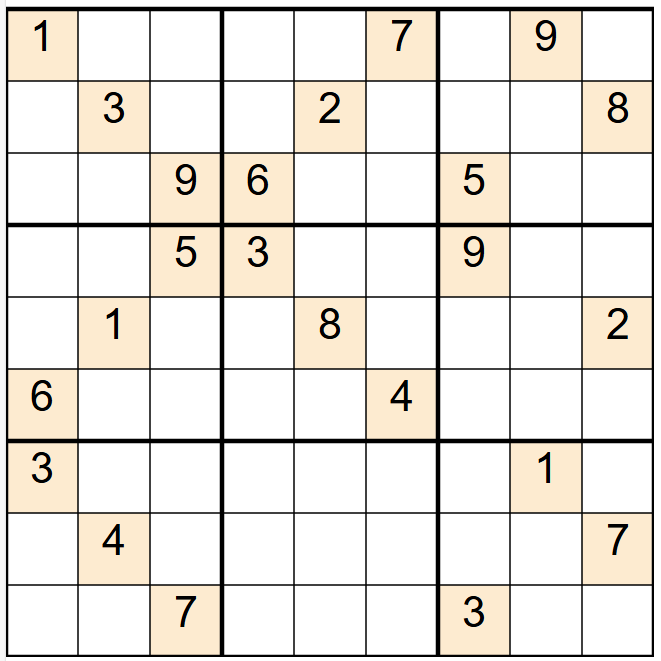
Creator: Arto Inkala, a Finnish applied mathematician renowned for crafting “unsolvable” puzzles as a hobby.
Historical Note: Released in late 2006, AI Escargot (named for its snail-like pattern and Inkala’s initials) was hailed as the world’s hardest Sudoku at the time. It beat early solvers like Sudoku Explainer v1.1 and sparked debates in forums like EnjoySudoku.
Though later eclipsed, it remains a benchmark for human-logic solvability, taking experts up to 24 hours by hand. Computational ratings place it at HoDoKu 11.9—brutal for its era.
Why It’s Hard: With 58 givens (fewer than average), it lacks early bi-values or bi-locations, forcing chained inferences across the grid. The top three blocks nearly form a full 1-9 set but with a duplicated 9, creating deceptive near-solutions that trap novices.
Solving Strategy:
Begin by thoroughly scanning rows 1–3 for naked singles. Because the top band is relatively constrained, several cells will resolve early once basic eliminations are applied. After placing these initial singles, update all pencil marks carefully across the entire grid.
Next, look for X-Wings on the digits 4 and 6. These X-Wings typically appear between the middle and lower bands and allow strong eliminations in the corresponding columns. Once the X-Wings are cleared, search for a Swordfish pattern on digit 2, most often found spanning columns 4, 5, and 6. This Swordfish removes several stubborn candidates and opens the path to more advanced chain logic.
The critical breakthrough comes from a forcing chain that starts at r7c9 (which can only be 8 or 9). Follow both branches of this chain carefully. One branch will quickly lead to a contradiction in box 9, allowing you to safely eliminate the opposite candidate. After this elimination, a cascade of naked and hidden singles appears. Expect the full solution to require 25 or more pure logical steps. Patience and precise candidate tracking are essential—no guessing is needed.
2. Golden Nugget
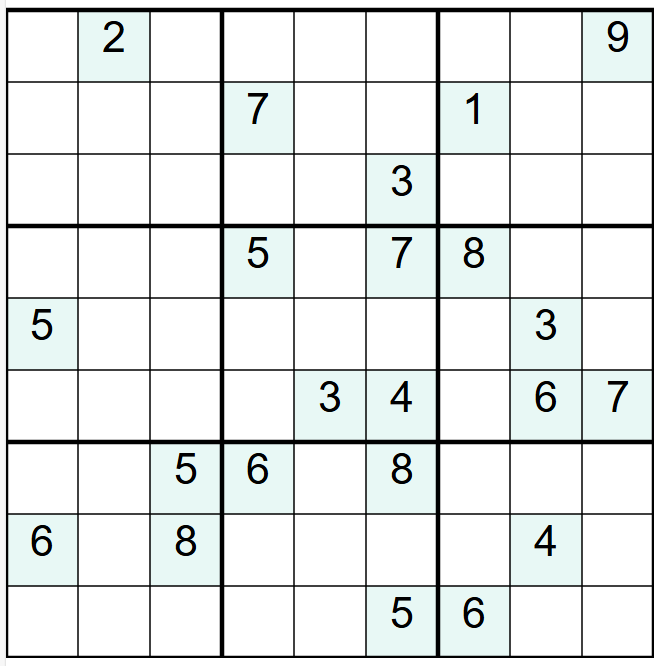
Creator: Arto Inkala, in his quest to push boundaries beyond AI Escargot.
Historical Note: Part of Inkala’s 2008-2010 series, Golden Nugget appeared in puzzle collections and was manually added to datasets for AI training due to its rarity. It’s featured in academic papers like “The Need to Visualize Sudoku” for its visualization challenges. Rated HoDoKu 9.5+, it embodies Inkala’s philosophy: minimal clues, maximum deception.
Why It’s Hard: Only 22 givens create a sparse, symmetric structure that mimics easier puzzles at first glance. Hidden contradictions lurk in boxes 2 and 8, demanding trial-and-error intertwined with chains—pure mental quicksand.
Solving Strategy:
Because the puzzle has only 22 givens, aggressive and accurate pencil-marking is mandatory from the very first step. Start by filling every empty cell with all possible candidates, then begin systematic elimination using basic techniques.
Focus special attention on row 5, where a hidden quad involving the digits 1–4 often appears. Resolving this hidden quad removes a large number of candidates and creates several bi-value cells. From these bi-value cells, begin constructing short XY-chains and XY-Wings, particularly those that affect columns 2 and 8.
A key advanced step involves assuming the candidate 6 in r4c4 and following the resulting chain. This assumption quickly produces a deadly pattern (Unique Rectangle or similar) inside box 5, proving that r4c4 cannot be 6. After this elimination, additional XY-Wings and short forcing chains become available. Most experienced solvers report that the puzzle takes two hours or more of careful, uninterrupted work.
3. Al Escargot II
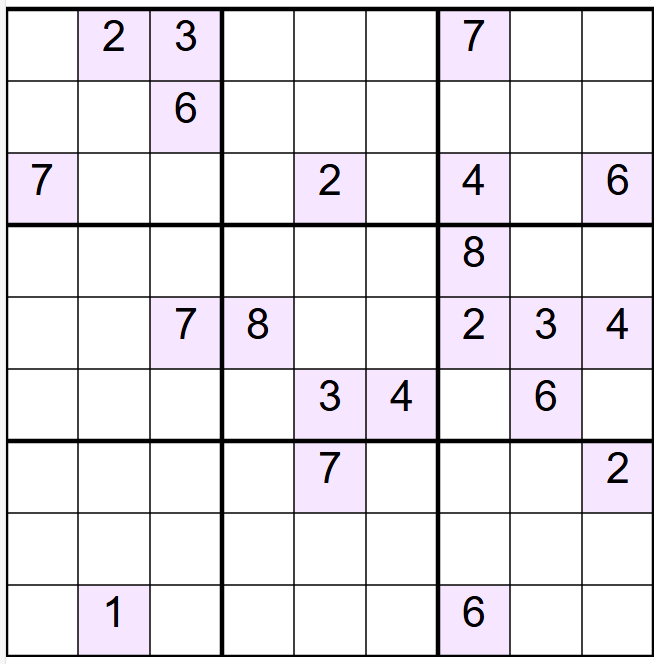
Creator: Arto Inkala, as a direct sequel to his 2006 masterpiece.
Historical Note: Released around 2009-2010, this “II” variant refined the original’s snail shape with even fewer clues (21 givens). It appeared in solver benchmarks and Quora discussions, where mathematicians geek out over its loop count (25+ iterations for brute-force algos). HoDoKu rates it 12.2—harder than its predecessor.
Why It’s Hard: Deeper sparsity means fewer starting singles; the grid’s “inescapable” pairs in boxes 4 and 6 force recursive deductions, often looping solvers back to square one.
Solving Strategy:
This sequel is even sparser than the original, so early singles are scarce. Begin by identifying empty rectangles, especially those located in rows 4–6. These empty rectangles provide the first meaningful eliminations and create a few bi-value cells that can be used for chaining.
Next, examine Almost Locked Sets (ALS) involving the digit 5 in column 3. The interaction between these ALS and nearby bi-value cells produces strong eliminations that open the lower part of the grid.
The decisive technique is a long forcing chain that begins at r8c1. This cell has two candidates that each lead to extensive chains. One path will eventually create a contradiction, allowing you to eliminate that candidate safely. After the correct branch is chosen, a series of singles and pairs appears, leading to the solution. Recursive checking of chains is often necessary because the grid contains several near-loops that can send solvers back to earlier positions.
4. World’s Hardest Sudoku (Daily Mail, 2010)
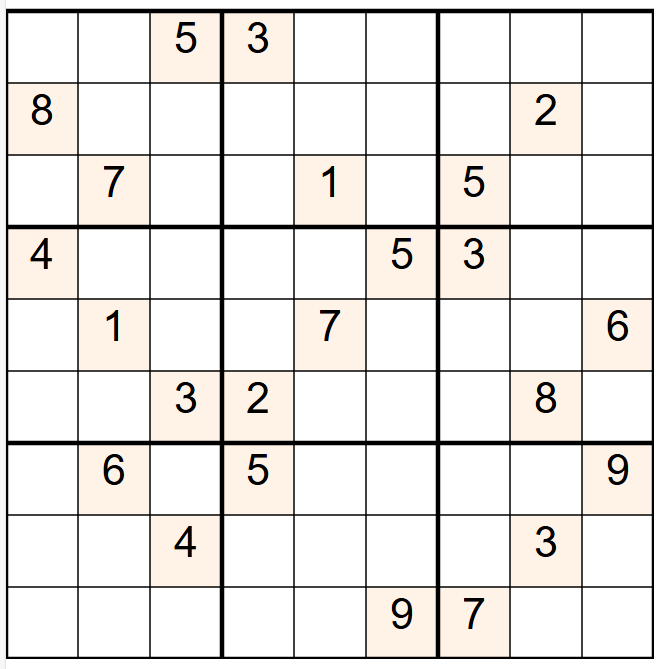
Download World’s Hardest Sudoku
Published by: UK’s Daily Mail, commissioned from Arto Inkala.
Historical Note: Dubbed “Al Escargot” in some circles, this 2010 beast went viral, stumping readers for days. Inkala spent three months on it using custom software; it rates HoDoKu 11.3 and was solved by experts in under 30 minutes—impressive for humans. Featured in ABC News as “the hardest-ever.”
Why It’s Hard: Just 23 givens scatter clues unevenly, creating a “wearying trial-and-error” web where each fill demands 8-9 step lookahead.
Solving Strategy:
Start with simple coloring on the digits 1 and 9. These two digits form several strong links that can be colored to reveal immediate eliminations and a few forced placements.
Once the coloring has cleaned the grid somewhat, apply Nishio (a controlled form of bifurcation) on the cell r2c9. Follow both possible candidates carefully, looking for contradictions without full backtracking. One of the two branches will collapse quickly, giving you a solid elimination.
After this step, a hidden pair appears in box 7. Resolving the hidden pair unlocks the middle game and produces a cascade of naked singles and pairs. The remainder of the puzzle can then be finished with standard intermediate techniques. Although the grid looks extremely sparse, the combination of coloring and controlled Nishio makes it solvable by pure logic in under 30 minutes for highly experienced solvers.
5. Platinum Blonde
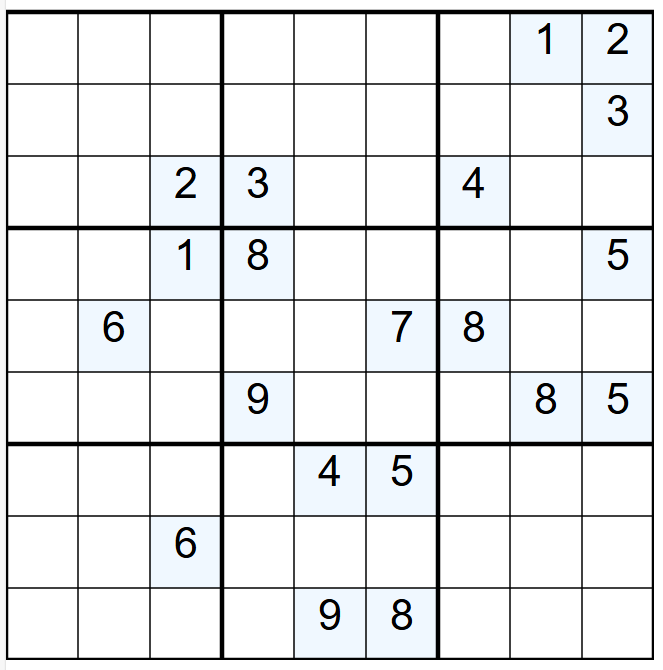
Creator: Anonymous, but popularized in Sudoku forums around 2012.
Historical Note: Named for its “deceptively simple” look, it topped Wikipedia’s hardest list and starred in Nature’s “Chaos Within Sudoku” paper (2012), where its solving dynamics showed transient chaos. Rated 3.5789 on a “Richter scale” of hardness—ultra-hard.
Why It’s Hard: Starts innocently but hides floors (stacked contradictions) in boxes 3 and 7, requiring J-Exocet patterns that baffle standard solvers.
Solving Strategy:
Begin with basic scanning to locate a hidden pair of 2 and 3 in row 3. This hidden pair is one of the few early gifts the puzzle offers and should be resolved immediately.
Next, examine box 5 for a naked triple. Clearing this triple removes several candidates and creates useful bi-value cells. The real difficulty lies in the “floors” (stacked contradictions) hidden in boxes 3 and 7. These require the use of Unique Rectangles involving the digits 4 and 7 in columns 4 and 5.
Once the Unique Rectangles are properly applied, a series of advanced pattern-based eliminations (including possible J-Exocet patterns) become available. After these patterns are cleared, the grid finally yields to more conventional chain logic and singles.
6. Inescapable Puzzle
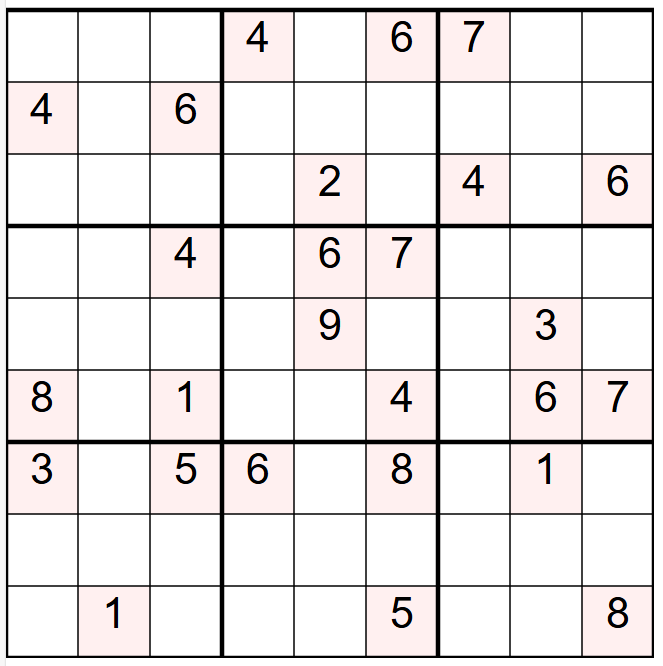
Creator: Unknown, but circulated in extreme puzzle archives since 2011.
Historical Note: Known for inducing “endless loops” in early AI solvers, it’s a staple in backtracking algorithm tests. Less documented than Inkala’s works, but forum vets rate it HoDoKu 10.8 for its trap-heavy design.
Why It’s Hard: Engineered dead ends mimic valid paths, forcing exhaustive exploration of unique rectangles that “inescapably” eliminate options.
Solving Strategy:
The puzzle is deliberately constructed with many dead-end paths, so multi-step chain construction from box 2 is the safest starting approach. Build short and medium-length chains that explore the interactions between boxes 2, 5, and 8.
Pay close attention to the lower three rows (rows 7–9), where several “inescapable pairs” exist. These pairs look solvable but repeatedly lead to contradictions unless the correct order of eliminations is followed.
A critical trial point is the cell r9c5. Assuming one of its candidates and following the resulting long chain will eventually produce a clear contradiction, allowing you to eliminate that candidate. After this breakthrough, the remaining “inescapable” loops collapse and the puzzle can be finished with standard techniques.
7. Impossible Sudoku (Times of India, 2012)
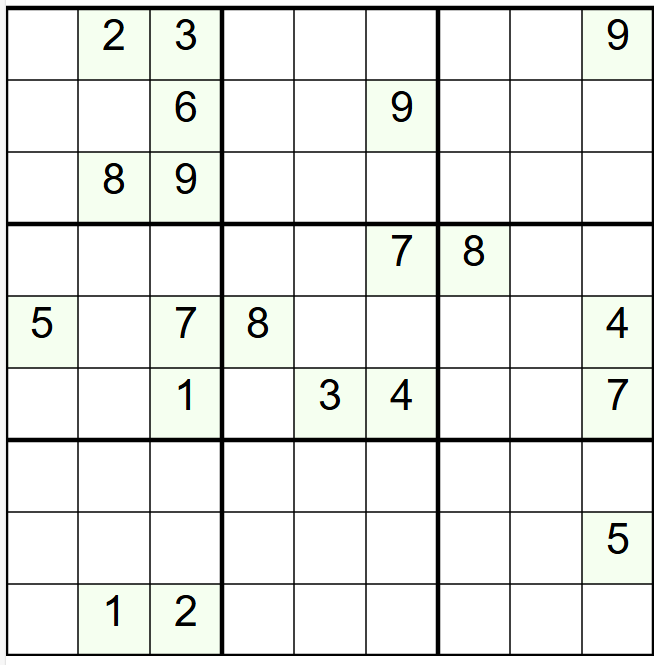
Published by: Times of India, during their Sudoku Championship era.
Historical Note: Tied to India’s 2012 championship (won by Rohan Rao), this “impossible” entry baffled contestants. With ties to LMI events, it’s part of a legacy of national brain-teasers. Rated extreme for backtracking needs.
Why It’s Hard: Ultra-sparse (20 givens), it requires candidate tracking across the entire grid, often hitting solver limits.
Solving Strategy:
With only 20 givens, the 45-rule (the fact that every row, column, and box sums to 45) becomes unusually useful for identifying subset combinations early. Use this arithmetic insight to limit candidates in the more constrained units.
Because the grid is extremely sparse, systematic candidate tracking across the entire board is essential. Coloring on multiple digits helps keep the chains organized.
The most effective approach is controlled trial-and-error starting in box 1. Choose a bi-value cell inside box 1, follow both branches with careful coloring, and look for contradictions. One branch will fail relatively quickly, providing a solid elimination that opens the rest of the grid.
8. Everest Puzzle

Creator: Arto Inkala (2012 “Everest” variant).
Historical Note: Inkala’s magnum opus, dubbed “Everest” for its peak difficulty. Published in Metro News, it predicted its own surpassing—yet holds SE 10.6. Solved in DMs by pros via MSLS (Monster Short-Long Sets).
Why It’s Hard: 21 givens demand 8+ step lookaheads; overlaps create mountain-like escalation.
Solving Strategy:
This puzzle demands long, multi-step forcing chains almost from the beginning. Start by identifying the strongest bi-value cells and begin constructing chains that span several boxes.
Special attention should be given to columns 1–3, where overlapping patterns create escalating constraints that resemble climbing a mountain—each elimination makes the next step slightly harder. Pattern recognition (especially remote pairs and short XY-chains) in this left-hand side of the grid is crucial.
Once a few key eliminations are secured through long forcing chains, the upper and middle bands begin to resolve. The final stage still requires careful chain work, but the densest part of the climb is over.
9. Inkala’s Final Boss
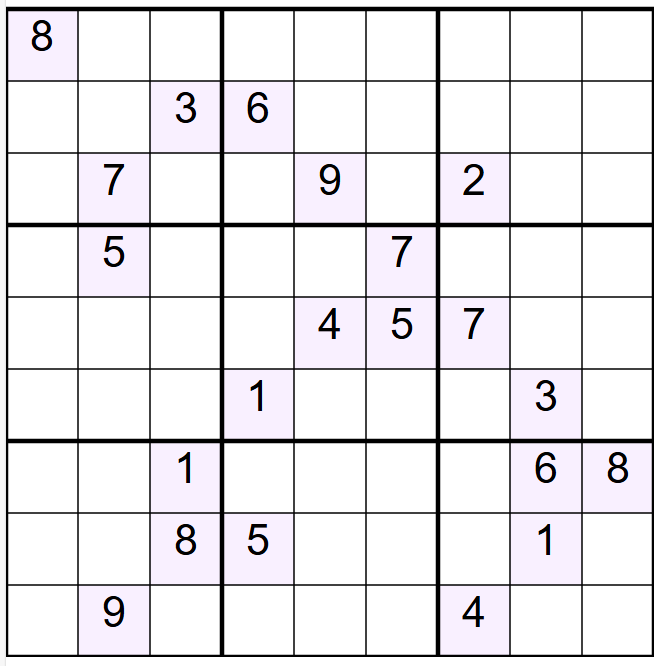
Creator: Arto Inkala’s ultimate 2012 challenge.
Historical Note: Often called “Inkala’s Maze,” it’s the pinnacle of his work—SE 11.2, requiring full uniqueness proof. Featured in solver GitHub repos and forums; one user spent 4 hours.
Why It’s Hard: Merges all techniques: floors, SK-loops, symmetries. Bifurcation explores opposites for proof.
Solving Strategy:
This is a true mastery-level puzzle that requires almost every advanced technique. Begin with the few available naked and hidden singles, then immediately move to Unique Rectangles and basic chain logic.
The core of the solution involves J-Exocet patterns combined with Unique Rectangles. These patterns appear in the central and lower parts of the grid and provide the major eliminations needed to progress.
After the J-Exocet and Unique Rectangle work is complete, long forcing chains and possible SK-loops become available. A critical branching point occurs at r1c6. Exploring both candidates from this cell (while maintaining a rigorous uniqueness proof) leads to the final breakthrough. The entire solve is an exercise in controlled, high-level logical exploration rather than any single dramatic technique.
🧠 Solving Strategies for Extreme Puzzles
Tackling these titans? Don’t dive in blind—equip yourself:
- Basics First: Hunt naked/hidden singles. Use pencil marks for candidates; the 45-rule (row/column/box sums to 45) reveals quick fills.
- Intermediate Tools: Pairs, triples, quads for eliminations. X-Wing/Swordfish spot alignments.
- Advanced Arsenal: Forcing chains, Unique Rectangles, ALS-XZ. For variants like Samurai, prioritize overlaps.
- Pro Tips: Stay patient—these can take hours (or days). Track progress in a notebook to avoid loops. Remember, even Inkala says the true hardest is undiscovered—keep hunting!
| Technique | Use Case | Example Puzzle |
|---|---|---|
| X-Wing | Row/column alignments | AI Escargot (4s) |
| Forcing Chains | Bifurcation paths | Everest |
| 45-Rule | Cage sums in Killer | Samurai |
| Unique Rectangle | Deadly patterns | Platinum Blonde |
Want to know more about Advance Sudoku Strategies for Experts. Just Click.
🎯 Final Words
Conquered the list? Or tapped out at #3? Share your times and war stories in the comments—did AI Escargot snail its way to victory, or did Platinum Blonde leave you dyed in frustration?
For daily doses of escalating difficulty, join our Daily Sudoku Challenge at SudokuTimes.com. Fresh grids, leaderboards, and community solvers await. What’s your Everest? Tackle it today—your brain will thank you (eventually).
FAQs On Hardest Sudoku Puzzles Ever Published
Q.1 – What is the hardest Sudoku puzzle ever published?
Ans- AI Escargot by Arto Inkala (2006) is widely regarded as the hardest classic 9×9 Sudoku ever published that can still be solved with pure logic. It held the title for years and still tops most expert lists.
Q.2 – Who created the hardest Sudoku puzzles?
Ans- Finnish mathematician Arto Inkala created the majority of the hardest puzzles, including AI Escargot, Golden Nugget, Al Escargot II, and Everest. He deliberately designs them to require the longest logical chains possible.
Q.3 – What is AI Escargot Sudoku?
Ans- AI Escargot is a 2006 Sudoku created by Arto Inkala. It is famous for its snail-shaped pattern of clues and its extremely high difficulty rating (around 11.8–12 on most solvers), making it one of the toughest human-solvable puzzles.
Q.4 – Is Platinum Blonde the hardest Sudoku?
Ans- Platinum Blonde (2012) is frequently cited alongside AI Escargot as one of the two hardest human-solvable Sudokus. It was analyzed in a Nature scientific paper for exhibiting “transient chaos” during solving.
Q.5 – What is the world’s hardest Sudoku called?
Ans- The puzzle most commonly called the “world’s hardest Sudoku” is Arto Inkala’s 2010 creation published by the Daily Mail, sometimes referred to as “World’s Hardest Sudoku” or a variant of Al Escargot.
Q.6 – How long does it take to solve the hardest Sudoku?
Ans- Expert human solvers typically need 2–24 hours for the hardest puzzles (AI Escargot, Platinum Blonde, Everest). Some have taken several days when solving completely by hand without software hints.
Q.7 – Are there Sudoku puzzles harder than AI Escargot?
Ans- Yes. Platinum Blonde, Al Escargot II, and Inkala’s 2012 Everest puzzle are generally rated slightly harder than the original AI Escargot by modern rating systems (HoDoKu, Sukaku Explainer).
Q.8 – What is the highest Sudoku difficulty rating?
Ans- The highest rated classic 9×9 Sudokus score around 11.9–12.0 on HoDoKu and 12,000+ on Sudoku Explainer. AI Escargot, Platinum Blonde, and Everest are consistently in this range.
Q.9 – Can the hardest Sudoku puzzles be solved without guessing?
Ans- Yes, all nine puzzles in the hardest list have a unique solution and can be solved using only advanced logical techniques (forcing chains, unique rectangles, XY-wings, etc.)—no trial-and-error guessing is required.
Q.10 – Where can I download the hardest Sudoku puzzles?
Ans- The grids for AI Escargot, Golden Nugget, Platinum Blonde, Everest, and the others are freely available on sites like sudokuwiki.org, krazydad.com, and various Sudoku forums that archive Arto Inkala’s puzzles.

M K Singh is a Sudoku enthusiast and content contributor at Sudoku Times. With over 14 years of experience in a government institution, he brings a disciplined and analytical mindset to problem-solving. A dedicated Sudoku lover for more than 17 years, he enjoys tackling puzzles of all difficulty levels and exploring advanced techniques. Through his writing, M K aims to share practical tips, strategies and insights that help fellow enthusiasts improve their skills and enjoy the game even more.