


Sudoku puzzles continue to captivate millions worldwide as one of the most popular logic games. Whether you’re a fan of easy Sudoku, challenging hard Sudoku puzzles or searching for the best Sudoku app and printable Sudoku grids, understanding how these puzzles come to life adds a new layer of appreciation. In this comprehensive guide, we’ll explore the fascinating process behind how Sudoku puzzles are created, from basic rules to advanced algorithms used in modern Sudoku solver tools.
If you’re into Sudoku techniques, brain training or even creating your own puzzles for your blog or app, this post covers everything step-by-step.
A Quick History of Sudoku
Sudoku traces its roots to “Number Place,” invented by Howard Garns in the late 1970s in the United States. It gained massive popularity in Japan in the 1980s, where it was renamed Sudoku (meaning “single numbers”). Today, with digital tools and online Sudoku platforms, the puzzle remains a staple for mental fitness.
Modern creators blend traditional logic with powerful computing to generate thousands of unique puzzles daily.
Understanding the Sudoku Grid and Rules
A standard Sudoku is a 9×9 grid divided into nine 3×3 subgrids (called “boxes”). The goal is simple yet profound:
- Each row must contain numbers 1-9 exactly once.
- Each column must contain numbers 1-9 exactly once.
- Each 3×3 box must contain numbers 1-9 exactly once.
This Latin square foundation ensures every completed grid is a valid solution.
How Sudoku Puzzles Are Created: The Detailed Step-by-Step Process
This is the core of Sudoku puzzle design. Professional and amateur creators follow a structured yet creative workflow that combines mathematics, programming, and logic testing. Here’s an in-depth breakdown:
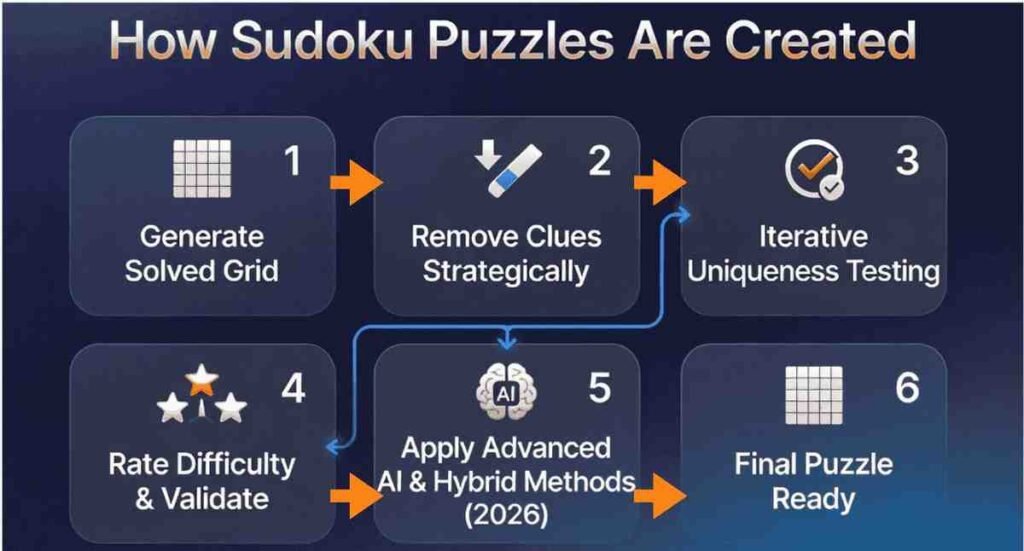
Step 1: Generate a Fully Solved (Complete) Sudoku Grid
Every puzzle begins with a valid, completed 9×9 grid where all rules are satisfied. This “solution grid” serves as the foundation.
Common Techniques for This Step:
- Backtracking Algorithm (Most Popular in Software): Start with an empty grid. Pick an empty cell, try numbers 1-9, check constraints, recurse forward on success, or backtrack on failure. It efficiently explores possibilities while pruning invalid paths.
- Mathematical Permutation Methods: Fill rows with permutations and apply controlled shifts or band/stack rearrangements to maintain validity across the entire grid.
- Seeding and Propagation: Place initial seeds and propagate constraints to fill the grid faster.
Step 2: Remove Numbers Strategically to Form the Puzzle (Clue Removal / “Digging Holes”)
This transformative phase turns a complete solution into an engaging, solvable puzzle. The goal is to remove as many numbers as possible while preserving a single unique solution and targeting a specific difficulty level. Poor removal can result in unsolvable grids or puzzles with multiple answers, so precision is critical.
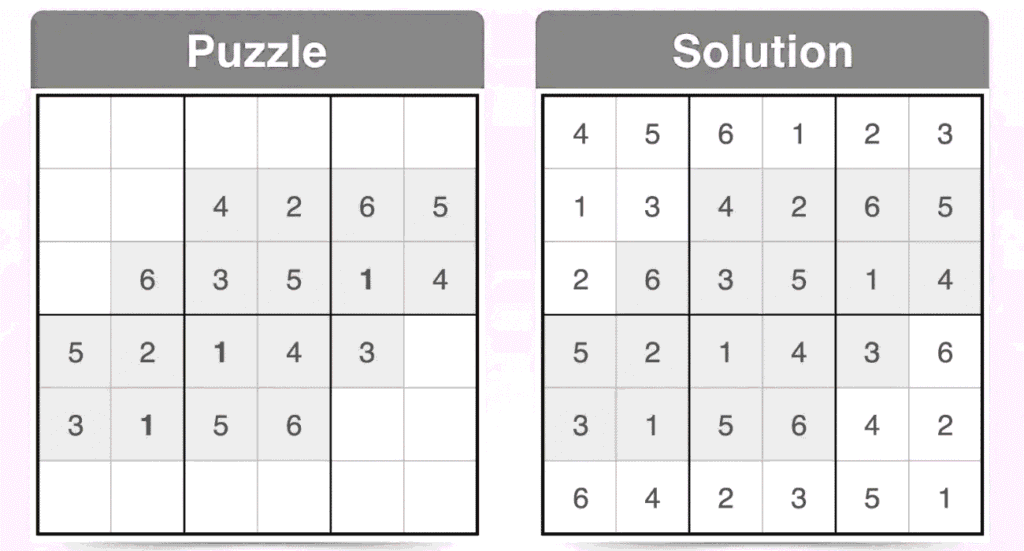
Here’s the detailed process:
1. Decide Difficulty Target– Begin by defining the desired challenge level. Count the number of clues (givens) you plan to leave:
- Easy Sudoku: Typically 36–50+ clues — relies on basic scanning and naked singles.
- Medium: 30–35 clues — introduces pairs and basic eliminations.
- Hard Sudoku: 22–29 clues — requires advanced patterns like X-Wing or Swordfish.
- Expert/Evil: Fewer than 22 clues — demands deep logic chains, uniqueness rectangles, and occasional bifurcations.
This target guides all subsequent removals and helps align with player expectations on online Sudoku platforms or printable Sudoku sheets.
2. Symmetrical or Patterned Removal– Remove numbers in a visually pleasing and balanced manner:
- Use rotational symmetry (180-degree) or mirror symmetry (vertical/horizontal/diagonal) by removing clues in pairs or groups of four. This creates elegant, professional-looking puzzles.
- Distribute removals evenly across rows, columns, and boxes to avoid over-emptying any single area, which could make the puzzle feel unbalanced or overly difficult in one region.
- Consider “patterned” removals where the empty cells form subtle shapes or leave certain numbers visible for aesthetic or thematic appeal (e.g., puzzles where given numbers spell a pattern).
3. Iterative Testing for Uniqueness– This is the most crucial and computationally intensive part:
- After removing one number (or a small batch), immediately run a full Sudoku solver on the partial grid.
- The solver checks whether exactly one valid completion exists. Efficient implementations use Dancing Links (DLX) algorithm or highly optimized backtracking with constraint propagation (candidate lists updated in real-time).
- If the puzzle now has zero solutions or multiple solutions, restore the most recently removed number and attempt to remove a different one instead.
- Repeat this process systematically, often prioritizing cells with higher impact (e.g., central cells or those with unique numbers). Many generators automate thousands of these trials per second.
4. Incorporate Difficulty Gradients– To create a smooth solving experience:
- Track which Sudoku techniques the remaining clues force the solver to use. For easier puzzles, prioritize removals that leave many “naked singles” (cells with only one possible candidate).
- For harder puzzles, deliberately remove clues that necessitate advanced methods like hidden triples, XY-Wing, or coloring techniques.
- Ensure a logical progression: early moves should be straightforward, gradually increasing in complexity toward the middle and end of the solve.
- Avoid “brute-force-only” puzzles that require excessive guessing without logical paths.
5. Final Validation–
- Manually solve the puzzle (or have beta testers do so) to confirm it feels fair, enjoyable, and free of ambiguities.
- Use automated rating systems that score based on metrics such as:
- The maximum depth of the solution tree.
- The number of times “guessing” (bifurcation) is required.
- The variety and frequency of techniques needed.
- Make final micro-adjustments, such as swapping the position of a few clues if the flow feels off.
Advanced Modern Approaches
In recent years, Sudoku generation has evolved far beyond basic algorithms, thanks to rapid advancements in artificial intelligence, machine learning and procedural content generation. These cutting-edge methods allow creators to produce higher-quality, more personalized and scalable puzzles faster than ever before.
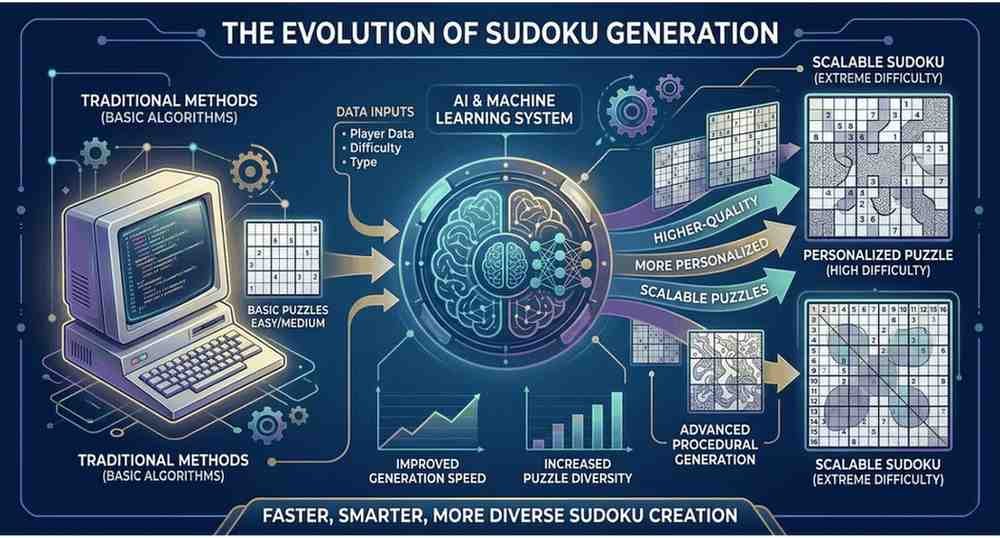
- AI-Assisted Generation with User Data Analytics: Modern systems analyze massive datasets collected from millions of solves on popular Sudoku solver apps and online platforms. By tracking metrics such as average solving time per difficulty level, dropout rates at specific steps, success percentages for different techniques, and even player feedback (e.g., “too hard” or “perfect flow”), AI models can dynamically predict and optimize puzzle difficulty in real time. For instance, reinforcement learning algorithms fine-tune clue removal by simulating thousands of virtual solvers with varying skill profiles. This results in puzzles that adapt to individual users — a beginner might receive extra gentle hints in the early grid, while experts get minimal-clue variants. Tools integrated with best Sudoku app ecosystems now personalize entire puzzle packs, improving retention and user satisfaction significantly.
- Procedural Generation with Customizable Parameters for Themed Puzzles: Procedural algorithms go beyond random removal by incorporating high-level parameters. Creators can specify themes such as holiday motifs (e.g., Christmas-themed puzzles where given clues form a tree or star pattern), educational integrations (puzzles that progressively teach Sudoku techniques like Swordfish in a tutorial series), or visual aesthetics (givens arranged to reveal hidden images when solved or printed). Parameters control symmetry type, minimum/maximum technique depth, regional difficulty variation (e.g., harder bottom-right quadrant), and even integration with external data (like generating puzzles based on current events or user birthdays). This approach powers printable Sudoku generators for niche blogs, classrooms and corporate wellness programs, making content fresh and shareable on social media.
- Hybrid Human-AI Workflows for Premium Handcrafted Feel: The most sought-after puzzles today combine the efficiency of AI with human creativity. AI first generates a base solved grid and initial clue set at record speed. Human designers (or expert Sudoku enthusiasts) then review and fine-tune: adjusting clue positions for better flow, introducing subtle symmetries, or adding “elegant” patterns that feel artistic rather than mechanical. This workflow is popular in top mobile apps, puzzle books, and premium subscription services. Some platforms even use collaborative tools where multiple creators vote on variations or use generative AI to suggest “what-if” modifications (e.g., “What if we remove this clue and add a unique rectangle opportunity?”). The result is puzzles that retain a premium, handcrafted quality while being produced at scale — perfect for content creators running Sudoku-focused sites who want to stand out with original, high-engagement material.
These advanced techniques not only accelerate production but also elevate the overall player experience, ensuring puzzles remain challenging yet solvable and enjoyable across all skill levels.
Tools and Software for Sudoku Creation in 2026
The landscape of Sudoku creation tools in 2026 is incredibly diverse, ranging from free open-source scripts to sophisticated AI-driven platforms. Whether you’re a hobbyist, developer, or professional content creator, there’s a tool for every need.
Beginner-Friendly Options:
- Online web-based generators (many free with instant download for printable Sudoku, for instance, sudokutimes.com).
- Mobile apps with built-in creators that let you generate, customize, and solve puzzles on the go.
Developer & Advanced Tools:
- Python Scripts: Simple backtracking implementations using libraries like NumPy or constraint solvers. Great for custom logic and batch generation.
- Open-source repositories on GitHub featuring DLX (Dancing Links) for ultra-fast uniqueness checking.
- AI-powered frameworks that incorporate machine learning for adaptive difficulty.
Professional & Platform Solutions:
- Integrated generators in popular Sudoku solver apps and websites.
- Enterprise-level procedural tools for mass production of themed puzzle packs.
A standout example is sudokutimes.com, where users can generate their own puzzles at their wish. The platform offers customizable options for difficulty levels, symmetry styles, and even technique-focused puzzles, making it ideal for casual solvers, teachers, or bloggers looking to create fresh content quickly. Features like instant PDF export for printables and integration with solving tutorials enhance its value for the community.
Many best Sudoku app options in 2026 now include creator modes with AI assistance, real-time previews and analytics on how players engage with generated puzzles. Cloud-based tools also allow collaboration, so teams can refine puzzles together.
Why Uniqueness Matters & Difficulty Rating
A great puzzle must be solvable logically without multiple solutions. This validation step separates high-quality puzzles from frustrating ones.
Conclusion: The Art and Science of Sudoku
How Sudoku puzzles are created beautifully combines mathematics, logic and creativity. The expanded clue-removal process highlights why well-designed puzzles feel rewarding.
Next time you solve one, appreciate the meticulous work behind it. Ready to generate your own? Experiment with the techniques shared here and share your results!
FAQs on How Sudoku Puzzles Are Created
Q.1- How are Sudoku puzzles created from start to finish?
Ans: Sudoku puzzles are created in two main phases: first generating a complete solved 9×9 grid using methods like backtracking or mathematical permutations, then strategically removing numbers (clue removal or “digging holes”) while ensuring the puzzle has exactly one unique solution and matches the target difficulty level. The process involves symmetry, iterative testing, and validation.
Q.2- What is the backtracking algorithm in Sudoku generation?
Ans: Backtracking is a popular computational method where the program tries placing numbers 1-9 in empty cells, checks row/column/box constraints, moves forward on valid placements, and backtracks when it reaches a dead-end. It is highly effective for generating valid solved grids quickly.
Q.3- Why is ensuring a unique solution important when creating Sudoku puzzles?
Ans: A unique solution guarantees the puzzle is fair and solvable through logic alone. Multiple solutions would make it ambiguous and frustrating, while no solution renders it invalid. Iterative solver checks during clue removal enforce this.
Q.4- How do creators control the difficulty level of a Sudoku puzzle?
Ans: Difficulty is controlled by the number of clues left (more clues = easier), their positions, and the advanced solving techniques required. Creators use rating systems that analyze solution depth, technique variety, and guess requirements.
Q.5- What are some advanced Sudoku generation methods used in 2026?
Ans: In 2026, methods include AI-assisted generation using user data analytics, procedural generation for themed puzzles, and hybrid human-AI workflows that combine speed with creative fine-tuning for premium quality.
Q.6- Which tools and software are best for creating Sudoku puzzles?
Ans: Options range from simple Python backtracking scripts and open-source DLX solvers to advanced AI platforms and apps. Platforms like sudokutimes.com allow users to generate custom puzzles easily with various difficulty and style options.
Q.7- What is symmetrical clue removal in Sudoku creation?
Ans: Symmetrical removal involves taking out numbers in pairs or groups (e.g., 180-degree rotational or mirror symmetry) to create visually balanced and aesthetically pleasing puzzles that look professional.
Q.8- Can I create my own Sudoku puzzles for my blog or website?
Ans: Yes, absolutely. Use online generators, Python scripts, or tools on sudokutimes.com to create puzzles. Focus on uniqueness testing, add custom visuals/tables, and optimize for SEO with proper difficulty levels.
Q.9- How does AI improve Sudoku puzzle creation in 2026?
Ans: AI analyzes solving data to dynamically adjust difficulty, generates themed or personalized puzzles, and assists in hybrid workflows. This results in better player engagement and scalable high-quality content production.
Q.10- What makes a well-designed Sudoku puzzle enjoyable?
Ans: A good puzzle has a unique solution, logical progression of techniques, balanced difficulty, aesthetic symmetry, and no unnecessary guessing. It should feel challenging yet fair, encouraging solvers to improve their Sudoku techniques.
Q.11- Are printable Sudoku puzzles still popular in the digital age?
Ans: Yes, printable versions remain highly popular for offline solving, classrooms, and gifting. Modern generators make it easy to create customized printable Sudoku grids with chosen difficulty and themes.
Q.12- How can beginners start learning to create Sudoku puzzles?
Ans: Start with simple Python backtracking scripts or free online tools. Practice generating solved grids first, then experiment with clue removal and uniqueness testing. Resources on sudokutimes.com and tutorials on advanced techniques are excellent starting points.

M K Singh is a Sudoku enthusiast and content contributor at Sudoku Times. With over 14 years of experience in a government institution, he brings a disciplined and analytical mindset to problem-solving. A dedicated Sudoku lover for more than 17 years, he enjoys tackling puzzles of all difficulty levels and exploring advanced techniques. Through his writing, M K aims to share practical tips, strategies and insights that help fellow enthusiasts improve their skills and enjoy the game even more.