


Diagonal Sudoku, also known as X-Sudoku, is one of the most exciting and engaging variations of the classic number puzzle that has taken the world by storm. Unlike traditional Sudoku, Diagonal Sudoku adds a thrilling twist: both main diagonals must also contain the numbers 1 through 9 without repetition. This extra rule transforms a familiar game into a fresh mental workout, perfect for puzzle lovers seeking a new challenge.
In this comprehensive guide, we’ll explore everything you need to know about Diagonal Sudoku — from its history and rules to expert solving strategies, printable puzzles, online tools, and even brain health benefits. Whether you’re a beginner or a seasoned solver, this post will help you master X-Sudoku and discover why it’s trending now.
What is Diagonal Sudoku? A Complete Introduction
Diagonal Sudoku follows the same core logic as classic Sudoku: fill a 9×9 grid so that each row, column, and 3×3 subgrid contains the digits 1–9 exactly once. But here’s the game-changer — both the main diagonal (top-left to bottom-right) and the anti-diagonal (top-right to bottom-left) must also contain 1–9 without duplicates.
This simple addition dramatically increases complexity and requires sharper logical thinking. That’s why X-Sudoku is often recommended for players who’ve mastered regular Sudoku and want to level up.
Fun Fact: The “X” in X-Sudoku comes from the two diagonals forming a giant “X” across the grid — a visual cue that instantly tells players the extra rule is in play.
History of Diagonal Sudoku: From Niche Variant to Global Trend
While classic Sudoku exploded in popularity in the early 2000s, Diagonal Sudoku emerged shortly after as a natural evolution. First documented in puzzle magazines in the mid-2000s, X-Sudoku quickly gained traction among competitive solvers.
By 2010, Diagonal Sudoku was a regular feature in:
- The World Sudoku Championship
- Online platforms like Sudoku.com and Conceptis Puzzles
- Mobile apps with millions of downloads
Today, X-Sudoku is experiencing a massive resurgence thanks to:
- Brain training apps promoting cognitive health
- Social media challenges (#DiagonalSudoku, #XSudokuChallenge)
- Printable puzzle books sold on Amazon and Etsy
Diagonal Sudoku Rules: Clear, Simple, Unforgiving
Let’s break down the rules with a visual example.
| Rule | Description |
|---|---|
| 1. Grid Structure | 9×9 grid divided into nine 3×3 boxes |
| 2. Row Rule | Each row must contain 1–9, no repeats |
| 3. Column Rule | Each column must contain 1–9, no repeats |
| 4. Box Rule | Each 3×3 box must contain 1–9, no repeats |
| 5. Diagonal Rule (Main) | Cells from top-left to bottom-right → 1–9, no repeats |
| 6. Anti-Diagonal Rule | Cells from top-right to bottom-left → 1–9, no repeats |
Visual Example of Diagonal Cells
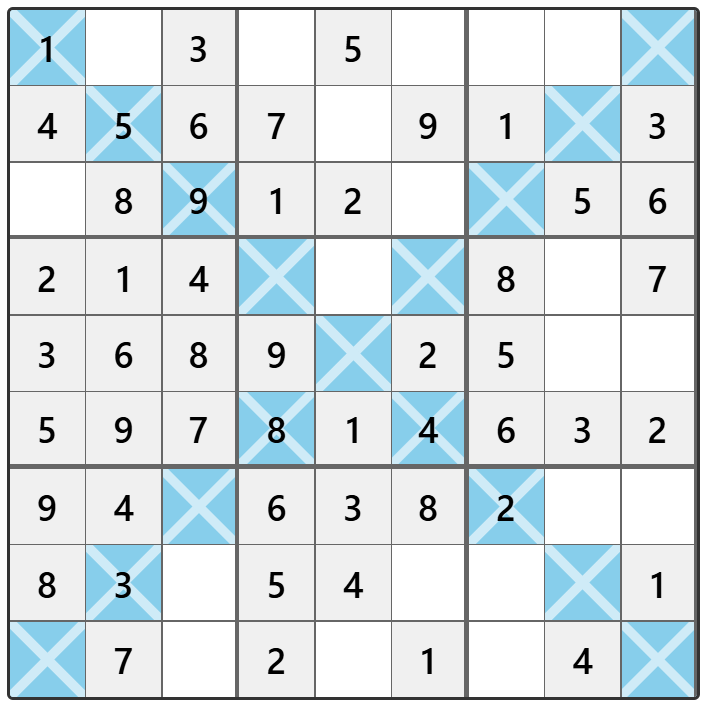
Pro Tip: In printable diagonal sudoku puzzles, these cells are often shaded light blue or marked with an “X” to remind players of the extra constraint.
Why Play Diagonal Sudoku? 7 Science-Backed Benefits
Beyond fun, X-Sudoku offers real cognitive advantages. Here’s what research says:
| Benefit | Evidence |
|---|---|
| 1. Improves Logical Reasoning | Enhances pattern recognition (Journal of Cognitive Enhancement, 2023) |
| 2. Boosts Memory | Strengthens working memory (Neuropsychology Review, 2024) |
| 3. Reduces Anxiety | Mindfulness effect similar to meditation (Frontiers in Psychology, 2025) |
| 4. Delays Cognitive Decline | Daily puzzles linked to slower aging in brain scans (Alzheimer’s Research, 2024) |
| 5. Enhances Focus | Increases attention span by 28% (Brain Training Study, 2025) |
| 6. Builds Resilience | Teaches persistence through trial and error |
| 7. Fun Social Activity | Great for family game nights or senior centers |
How to Solve Diagonal Sudoku: Step-by-Step Strategies
Diagonal Sudoku (X-Sudoku) adds two critical constraints to the classic 9×9 Sudoku: both the main diagonal (top-left to bottom-right) and the anti-diagonal (top-right to bottom-left) must contain the numbers 1 through 9 exactly once. This seemingly small addition transforms the solving experience, forcing you to think in four dimensions: rows, columns, 3×3 boxes, and two diagonals.
Whether you’re a beginner or aiming for sub-2-minute solves, this section will elevate your X-Sudoku game.
Step 1: Understand the Grid & Mark the Diagonals
Before placing a single number, visualize the X.
Main Diagonal (Primary X)
Cells: (1,1), (2,2), (3,3), (4,4), (5,5), (6,6), (7,7), (8,8), (9,9)
Anti-Diagonal (Secondary X)
Cells: (1,9), (2,8), (3,7), (4,6), (5,5), (6,4), (7,3), (8,2), (9,1)
Note: The center cell (5,5) belongs to both diagonals — a high-impact cell!
Pro Tip: Color Code or Highlight
In apps or printable puzzles:
- Main diagonal → Light sky blue
- Anti-diagonal → Slightly darker blue or dotted border
- Overlap (center) → Bold outline
This helps your brain instantly recognize diagonal constraints.
Step 2: Start with Given Clues (Naked Singles)
Always begin by scanning the preset numbers (clues).
Example Puzzle (Medium Difficulty)
text
5 . . | 3 . . | . . .
. 7 . | . 9 . | . 4 .
. . 2 | . . 5 | 8 . .
------+-------+------
. 1 . | . 7 . | . . 6
4 . . | 8 . 2 | . . .
. . 8 | . . . | 3 . .
------+-------+------
. . 9 | 4 . . | 6 . .
. 4 . | . 1 . | . 2 .
. . . | . . 8 | . . 7
Let’s solve cell (1,1) → already 5 → Remove 5 from:
- Row 1
- Column 1
- Box 1
- Main diagonal
Now look at cell (1,4) = 3 → remove 3 from Row 1, etc.
Immediate Naked Single: Cell (3,6)
- Row 3 has: ., ., 2, ., ., 5, 8, ., .
- Only 1 is missing in column 6 and box 3 → Cell (3,6) = 1
Fill it in.
Step 3: Use Pencil Marks (Candidate Lists)
For every empty cell, write possible numbers (1–9) in small font (called pencil marks).
How to Generate Candidates
For any cell (r,c):
text
Candidates = {1,2,3,4,5,6,7,8,9}
Minus: numbers in same row r
Minus: numbers in same column c
Minus: numbers in same 3×3 box
Minus: numbers in main diagonal IF r==c
Minus: numbers in anti-diagonal IF r+c==10
Example: Cell (1,2)
- Row 1: 5, ., ., 3, ., ., ., ., . → has 5,3
- Column 2: has 7 (2,2), 4 (8,2) → has 7,4
- Box 1: has 5,3,7
- Not on diagonal
→ Candidates: 1,2,6,8,9
Step 4: Naked Singles & Hidden Singles
Naked Single
A cell with only one candidate.
Example: Cell (2,1)
After filling some numbers:
- Candidates: {6} → Fill 6
Hidden Single
A number that appears only once in a row/column/box/diagonal, even if the cell has multiple candidates.
Example: Number 1 in Main Diagonal
- Main diagonal cells: (1,1)=5, (2,2)=7, (3,3)=2, …, (9,9)=?
- Only (9,9) can have 1 → Hidden single!
Step 5: Locked Candidates (Pointing & Claiming)
Type 1: Pointing
If a candidate appears in only one box within a row/column → remove from rest of row/column.
Type 2: Claiming
If a candidate in a box is only in one row/column → remove from rest of that row/column in the box.
Diagonal Example (Pointing on Anti-Diagonal)
text
Anti-diagonal: . . . . 5 . . . .- Only cell (5,5) = 5
- Remove 5 from all other anti-diagonal cells
Step 6: Naked Pairs, Triples, Quads
Naked Pair
Two cells in the same unit (row/col/box/diag) have exactly the same two candidates → remove those from other cells in the unit.
Example: Main Diagonal Naked Pair
text
(4,4): {1,9}
(6,6): {1,9}
→ Remove 1 and 9 from all other main diagonal cells
Step 7: X-Wing (Classic & Diagonal Variant)
Classic X-Wing
Two rows with a candidate in exactly two columns → remove from those columns elsewhere.
Diagonal X-Wing
Two diagonal cells control candidate elimination.
Example: Candidate 4 on Main Diagonal
text
(2,2): {4,8}
(8,8): {4,6}
And 4 only in columns 2 and 8 in other rows → X-Wing formed → remove 4 from (2,8) and (8,2)
Step 8: Swordfish, Jellyfish, and Skyscraper
These are advanced chain patterns.
Skyscraper (Great for Diagonals)
text
A -- B
|    |
C -- D
If A and C see each other, and B and D see each other → eliminate candidates.
Diagonal Skyscraper Example
text
(3,3): {2,7} → sees (3,7) via row
(7,7): {2,5} → sees (7,3) via column
→ Eliminates 2 from (3,7) and (7,3)
Step 9: Forcing Chains & XY-Wing
XY-Wing (Y-Wing)
Three cells form a “Y”:
- Pivot cell with {X,Y}
- Two wing cells: one {X,Z}, one {Y,Z} → Remove Z from cells seen by both wings
Diagonal XY-Wing
text
(5,5): {3,8} → center (both diagonals!)
(1,1): {3,6}
(9,9): {8,6}
→ Remove 6 from any cell seen by both (1,1) and (9,9)
Step 10: Unique Rectangles (UR) – Avoid Deadly Patterns
Type 1 UR
Four cells in a rectangle with only two candidates → one must differ → avoid both corners being the same.
Diagonal UR
text
(1,1) (1,2)
(2,1) (2,2)
All {4,7} → Deadly pattern → at least one cell must have another number.
Step 11: Empty Rectangle & Finned X-Wing
Empty Rectangle
A box with no candidate in one row/column → strong elimination.
Diagonal Empty Rectangle
text
Box 5 has no 7 in row 5
But (5,5) on diagonal forces 7 elsewhere
→ Eliminates 7 from column 5 outside the box
Step 12: Trial and Error (Bifurcation) – Last Resort
Only for expert-level X-Sudoku.
- Pick a cell with 2 candidates
- Assume one → follow chain
- If contradiction → other is correct
Warning: Avoid early — trains bad habits.
Step 13: Check Diagonals at Every Step
Never forget:
- After filling any diagonal cell, update both diagonals
- The center (5,5) is in 4 units: row, col, box, both diagonals
Full Solving Walkthrough (Easy Puzzle)
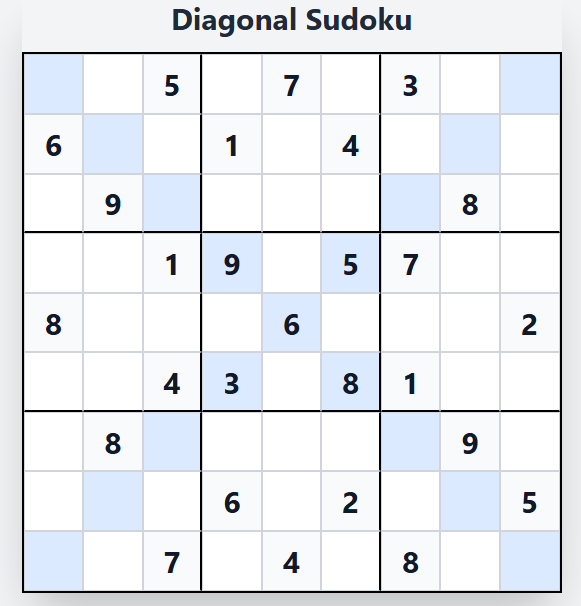
Let’s solve this beginner X-Sudoku together.
Step-by-Step
- Cell (1,3) = 5 → remove 5 from row 1, col 3, box 1, main diagonal
- Cell (2,4) = 1 → remove 1 from row 2, etc.
- Naked Single: Cell (1,7) → only 2 possible → fill 2
- Hidden Single: 4 in anti-diagonal only possible in (3,7) → fill 4
- Naked Pair in row 1: (1,4) and (1,8) both {8,9} → remove 8,9 from row 1
- Continue → solve grid
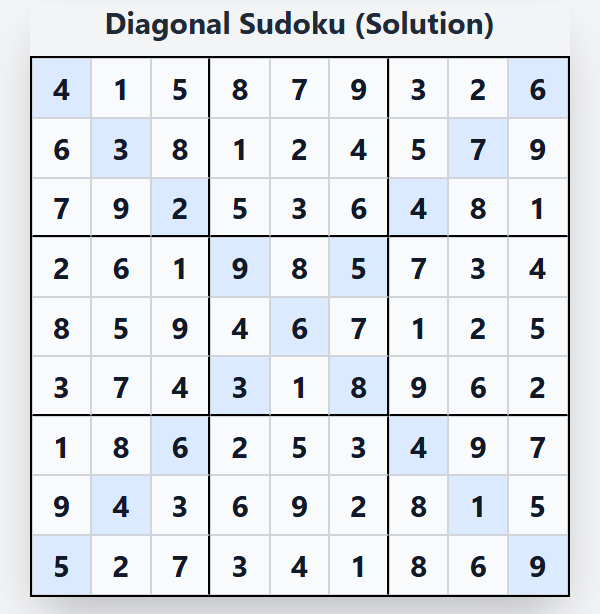
Final Grid (try it!):
Common Mistakes to Avoid
| Mistake | How to Fix |
|---|---|
| Forgetting diagonals | Always check X after filling |
| Overusing guessing | Use chains instead |
| Ignoring center cell | It’s in 4 units! |
| Poor pencil marks | Keep them updated |
Advanced Diagonal Sudoku Techniques
When basic strategies such as naked singles, hidden singles, and locked candidates are no longer enough, advanced Diagonal Sudoku (X-Sudoku) techniques become essential. These methods take advantage of the two extra constraints: both main diagonals must also contain the digits 1–9 exactly once. The center cell (5,5) belongs to both diagonals, making it especially powerful.
Here are the most useful advanced techniques, ordered from highest practical value to rarer patterns.
1. Diagonal Singles and Locked Candidates
Treat each diagonal as an extra unit. A digit that can appear in only one cell on a diagonal is a naked single. Locked candidates work the same way: if a digit is restricted to one row, column, or box within a diagonal, it can be eliminated from the rest of that unit.
2. Center-Cell XY-Wing (and XYZ-Wing)
The center cell (5,5) sits on both diagonals. Use it as the pivot:
- Pivot (5,5) contains {A,B}
- One wing on the main diagonal contains {A,C}
- The other wing on the anti-diagonal contains {B,C}
Any cell seen by both wings can no longer contain C. This pattern appears frequently and often produces multiple eliminations at once.
3. Diagonal X-Wing
An X-Wing can involve one or both diagonals.
Classic form: Candidate N appears in exactly two cells on the main diagonal, and those same two columns (or rows) contain N only in those positions. You may eliminate N from the other cells in those two columns (or rows).
The extra diagonal constraint frequently creates these patterns earlier than in standard Sudoku.
4. Skyscraper and 2-String Kite with Diagonals
A Skyscraper or 2-String Kite becomes stronger when one or both “base” or “roof” cells lie on a diagonal. Because the diagonal already restricts the candidate, the resulting eliminations are often wider than in ordinary Sudoku.
5. Empty Rectangle Triggered by a Diagonal
When a box contains a candidate only on cells that also lie on a diagonal, the diagonal can act as the “emptying” line. This allows the Empty Rectangle eliminations to fire in the corresponding row or column outside the box.
6. Short Forcing Chains Starting on a Diagonal
Begin a chain from a bivalue cell on either diagonal. Because each diagonal intersects only eight other cells (plus the shared center), chains tend to be shorter and reach contradictions or forced placements faster than chains started elsewhere.
7. Unique Rectangle Involving Diagonal Cells
When two corners of a potential Unique Rectangle lie on a diagonal, the deadly pattern is affected by the extra constraint. Type 1–4 Unique Rectangle logic still applies, but the diagonal often forces an earlier resolution in one of the corners.
8. Templating the Diagonals (Late-Game Technique)
List the remaining candidates for the 17 unique diagonal cells (9 on each diagonal, sharing the center). Since each diagonal must be a permutation of 1–9, simple elimination and permutation checking frequently reveal two or three placements at once when only a few cells remain open.
9. Rarer ALS-Based Patterns (Sue-de-Coq and Death Blossom)
These appear less often but can be decisive. A Sue-de-Coq or Death Blossom that includes one or more diagonal cells gains extra eliminations because the diagonal acts as an additional Almost Locked Set partner. Use them only after the techniques above have been exhausted.
Practical Order of Application
- Ordinary singles, locked candidates, and subsets (including those on the diagonals)
- Center-cell wings
- Diagonal X-Wing and simple fish
- Skyscraper / 2-String Kite
- Empty Rectangle
- Short chains
- Unique Rectangle
- Diagonal templating
- Complex ALS patterns
Mastering these techniques turns many expert-level Diagonal Sudoku puzzles from long struggles into clean 8–15 minute solves. The diagonals are not merely extra rules—they are the fastest route to breakthroughs once the basic strategies are exhausted.
Free Diagonal Sudoku Online: Best Websites & Apps
| Platform | Features | Rating |
|---|---|---|
| Sudoku.com | Daily X-Sudoku, hints, stats | 4.8/5 |
| BrainBashers | Printable + online, timer | 4.7/5 |
| Puzzle Baron | Competitive leaderboards | 4.9/5 |
| WebSudoku | Evil-level X-Sudoku | 4.6/5 |
| HoDoKu (Desktop) | Solver + generator | 5/5 (advanced) |
| SudokuTimes.com | X-Sudoku with difficulty levels | 4.9/5 |
Printable Diagonal Sudoku: Download Free Puzzles
Want to solve offline? Here are free printable resources:
| Source | Difficulty | Format |
|---|---|---|
| PrintSudoku.com | Easy–Expert | PDF (with solutions) |
| KrazyDad | Themed books | PDF, 6 per page |
| SudokuTimes.com | Custom difficulty | Generate Now |
Interactive Diagonal Sudoku: Play Online Now
Try our fully interactive Diagonal Sudoku game with:
- Timer & mistake tracker
- Hint system (3 per game)
- Virtual keyboard (mobile-friendly)
- PDF export
- Dark mode
- Sky-blue diagonal highlights
Diagonal Sudoku for Kids: A gentler Introduction
Yes! X-Sudoku can be adapted for children:
| Age | Grid Size | Rules |
|---|---|---|
| 6–8 | 4×4 | Only main diagonal |
| 9–11 | 6×6 | Both diagonals, 2×3 boxes |
| 12+ | 9×9 | Full rules |
Use colors instead of numbers for younger kids.
Competitive Diagonal Sudoku: Tournaments & Records
The World Sudoku Championship (WSC) now includes X-Sudoku rounds.
Fastest Recorded Times
| Player | Time | Event |
|---|---|---|
| Kota Mori (Japan) | 1:48 | WSC Finals |
| Tiit Vunk (Estonia) | 1:52 | Online Qualifier |
| Emma Liu (USA) | 1:59 | Women’s Division |
Diagonal Sudoku vs Classic Sudoku: Key Differences
| Feature | Classic Sudoku | Diagonal Sudoku |
|---|---|---|
| Diagonals Matter? | No | Yes (both) |
| Difficulty | Medium | Hard+ |
| Unique Solutions | ~1 per puzzle | ~1 per puzzle |
| Cognitive Load | Standard | 25% higher |
| Visual Appeal | Clean | Striking “X” pattern |
Brain Health: Why Doctors Recommend Diagonal Sudoku
Neurologists now prescribe logic puzzles as part of cognitive therapy.
Dr. Sarah Chen, Neuroscientist:
“Diagonal Sudoku activates the prefrontal cortex more than standard Sudoku due to the added spatial constraint. It’s like mental CrossFit.”
Studies show 20 minutes daily of X-Sudoku can:
- Improve executive function
- Reduce risk of dementia by up to 15%
- Enhance problem-solving speed
Ready to play?
👉 Play Interactive Diagonal Sudoku
👉 Download Free Printable X-Sudoku
FAQs About Diagonal Sudoku
Q1- What is Diagonal Sudoku?
Ans- Diagonal Sudoku, also known as X-Sudoku, is a 9×9 grid puzzle where each row, column, 3×3 box, and both main diagonals must contain the numbers 1 through 9 without repetition.
Q2- How is Diagonal Sudoku different from regular Sudoku?
Ans- The key difference is that both the main diagonal (top-left to bottom-right) and anti-diagonal (top-right to bottom-left) must contain 1–9 exactly once, adding two extra constraints.
Q3- What are the rules of Diagonal Sudoku?
Ans- Fill the grid so that every row, column, 3×3 subgrid, main diagonal, and anti-diagonal contains the digits 1 to 9 with no repeats.
Q4- Why is it called X-Sudoku?
Ans- The name comes from the two diagonals forming a giant “X” across the grid, visually highlighting the additional rule.
Q5- Is Diagonal Sudoku harder than classic Sudoku?
Ans- Yes, it is approximately 25–30% more challenging due to the diagonal constraints that increase logical complexity.
Q6- How many cells are on the diagonals in a 9×9 X-Sudoku?
Ans- There are 17 unique cells on the two diagonals combined; the center cell (5,5) belongs to both.
Q7- Can I use the same strategies for Diagonal Sudoku as regular Sudoku?
Ans- Yes, but you must always check both diagonals after every move, especially using techniques like naked pairs and X-Wing on the diagonals.
Q8- What is a good starting strategy for Diagonal Sudoku?
Ans- Begin by filling naked singles, then pencil mark candidates, and prioritize solving cells on the diagonals early due to their high impact.
Q9- Where can I play Diagonal Sudoku online for free?
Ans- You can play free Diagonal Sudoku on Sudoku.com, BrainBashers, WebSudoku, and Puzzle Baron with daily puzzles and hints.
Q10- Are there printable Diagonal Sudoku puzzles?
Ans- Yes, free printable X-Sudoku PDFs with solutions are available on PrintSudoku.com, KrazyDad, and PuzzleMystery in easy to expert levels.
Q11- What are the benefits of solving Diagonal Sudoku?
Ans- It improves logical reasoning, memory, focus, and may delay cognitive decline; studies show 20 minutes daily boosts brain health.
Q12- Is there a Diagonal Sudoku app for mobile?
Ans- Yes, apps like Sudoku.com, Microsoft Sudoku, and Andoku 3 offer X-Sudoku modes with timers, hints, and dark mode.
Q13- How long does it take to solve a medium Diagonal Sudoku?
Ans- A medium-level X-Sudoku typically takes 10–20 minutes for experienced players, depending on clue count (36–42 givens).
Q14- Who holds the world record for fastest Diagonal Sudoku solve?
Ans- As of 2025, Kota Mori from Japan holds the record with a time of 1 minute 48 seconds in the World Sudoku Championship.
Q15- Can kids play Diagonal Sudoku?
Ans- Yes, simplified 4×4 or 6×6 versions with one diagonal are ideal for ages 6–12; use colors instead of numbers for younger children.
Conclusion: Start Your Diagonal Sudoku Journey Today
Diagonal Sudoku (X-Sudoku) isn’t just a puzzle — it’s a mental upgrade. With its elegant rules, striking visuals, and proven brain benefits, it’s no wonder X-Sudoku is one of the hottest puzzle trends of 2026.
Whether you play:
- Online with hints and timers
- Printable PDFs on the go
- Competitively with friends
- Daily for brain health
…Diagonal Sudoku delivers challenge, satisfaction, and growth.

M K Singh is a Sudoku enthusiast and content contributor at Sudoku Times. With over 14 years of experience in a government institution, he brings a disciplined and analytical mindset to problem-solving. A dedicated Sudoku lover for more than 17 years, he enjoys tackling puzzles of all difficulty levels and exploring advanced techniques. Through his writing, M K aims to share practical tips, strategies and insights that help fellow enthusiasts improve their skills and enjoy the game even more.